
.gif)
.png)
.png)
.svg)
.svg)
.png)
.svg)

- Key Highlights:
- GST Rates on Gold and Silver at a Glance
- Latest Updates: Budget 2026 and the May 2026 Customs Duty Hike
- GST on Gold: Rates for Every Form
- GST on Silver: Rates for Every Form
- HSN Codes for Gold and Silver Under GST
- How to Calculate GST on Gold and Silver Purchases
- GST on Gold and Silver Investment Instruments
- Sovereign Gold Bonds, Gold ETFs and Gold Mutual Funds
- GST on Digital Gold
- Input Tax Credit (ITC) on Gold and Silver: Who Can Claim It?
- Gold vs Silver GST: Side-by-Side Comparison
- How GST Has Helped Buyers
- Should You Invest in Silver or Gold?
- Conclusion
- Frequently Asked Questions
Key Highlights:
- GST rates are applicable to both gold and silver in India.
- The GST rate for gold and silver might change based on how the metal is made.
- Having the right knowledge of gold and silver GST rates can help you save money and make better decisions with your investment.
- The GST Council’s 56th meeting (3 September 2025) confirmed that gold and silver will stay at 3% GST even after the GST 2.0 slab overhaul that took effect on 22 September 2025.
- Customs duty on gold and silver imports was more than doubled, from 6% to 15%, effective 13 May 2026. The GST rate itself has not changed, but landed bullion costs more.
Gold and silver, both metals, now has 3% GST on gold and silver transaction value, plus a separate 5% GST on jewellery making charges. This combination has not moved since GST was introduced on 1 July 2017, and it stays unchanged even after the GST 2.0 reforms rolled out on 22 September 2025. Gold investment routes such as sovereign gold bonds and gold ETFs remain outside GST altogether, though, as covered below, the bond scheme itself hasn’t had a fresh issue since February 2024.
GST on gold and silver allows pricing to be consistent across most markets in India. There may be marginal changes in the rates as per local demand or festivals, but it allows buyers to be sure that they’re not getting cheated. The introduction of a goods and services tax has eliminated indirect taxes such as VAT and service tax. People who wish to buy gold in any form, be it jewellery, gold coins, or gold bars, have to make sure they pay GST with their purchase. Let’s understand more about this topic in the guide below:
Also Read: GST on Buying, Selling & Exchanging Gold: Complete guide
GST Rates on Gold and Silver at a Glance
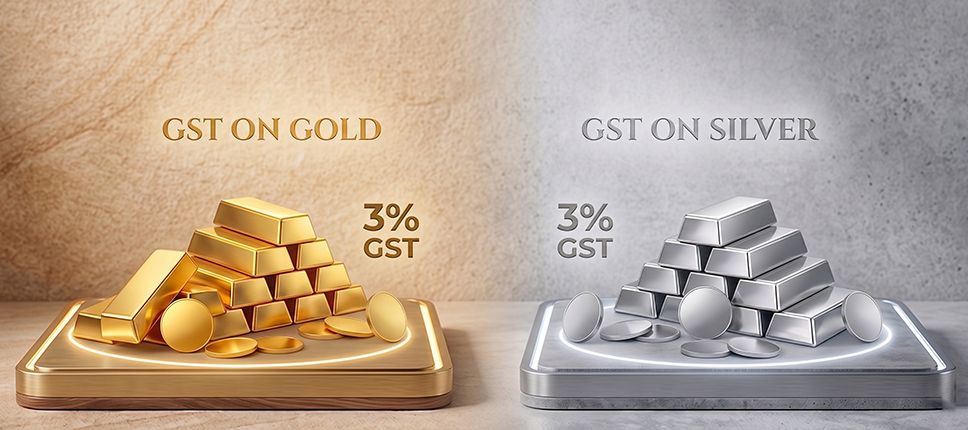
Gold and Silver GST Rates. First, let’s understand the GST rate on gold and silver in India. Both are subject to a 3% GST on their value. Additionally, sellers also charge 5%, making charges on both commodities.
Example:
Value of gold - 3% GST
Adding 5% GST to the prices you charge
In other words, when you buy gold or silver, your total price includes both of these taxes.
| Metal | Form | HSN Code | GST Rate |
|---|---|---|---|
| Gold | Bars and Coins | 7108 | 3% |
| Gold | Jewellery (Metal Value) | 7113 | 3% |
| Gold | Jewellery Making Charges | 9988 | 5% |
| Silver | Bars and Coins | 7106 | 3% |
| Silver | Jewellery (Metal Value) | 7113 | 3% |
| Silver | Jewellery Making Charges | 9988 | 5% |
| Both | Job Work by an Independent Karigar* | 9988 | 1.5% |
Both metals share an identical tax structure, 3% on the value of the metal and 5% on making charges, and this hasn’t shifted through the GST 2.0 rationalisation of September 2025. The GST on gold and silver in India doesn’t vary by state either, since GST is a destination-based national tax: 1.5% CGST + 1.5% SGST on an intra-state sale, or a flat 3% IGST on an inter-state sale or import.
Latest Updates: Budget 2026 and the May 2026 Customs Duty Hike
The GST tax on gold and silver itself is 3% on value and 5% on making charges. Gold, silver, diamonds and precious stones were deliberately kept on their own legacy rate of 3%/0.25% even after the GST 2.0 reforms.
The logic: these metals function as savings instruments and a livelihood for small jewellers, not as discretionary luxury spending, so raising the rate risked hurting household savings rather than curbing extravagance.
Customs duty is the part that has actually moved recently. The Union Budget 2025-26 (1 February 2025) and Budget 2026-27 (1 February 2026) both left import duty on gold and silver unchanged at 6% (5% basic customs duty plus 1% agriculture infrastructure and development cess). Then, on 12 May 2026, the government raised the basic customs duty to 10% and the cess to 5%, which took the effective import duty on gold and silver to 15% with effect from 13 May 2026. That move sits entirely outside GST, but it does raise the landed cost of imported bullion, which flows into retail jewellery and coin prices.
| Date | Customs Duty on Gold/Silver | What Changed |
|---|---|---|
| Jul 2024 (Budget) | 6% (5% BCD + 1% AIDC) | Cut from 15% |
| Feb 2025 (Budget) | 6% | Unchanged |
| Feb 2026 (Budget) | 6% | Unchanged |
| 13 May 2026 | 15% (10% BCD + 5% AIDC) | Raised - current rate |
GST on Gold: Rates for Every Form
Whether it’s a wedding necklace, a coin bought for Dhanteras, or a 100-gram bar sitting in a locker, gold is taxed the same way at the GST level. The differences show up in what counts as the taxable value, not in the rate.
24-Carat and 22-Carat Gold GST Rate
Both 24-carat and 22-carat gold attract the same GST rate on gold and silver: 3% on the transaction value. Purity doesn’t move the needle: an 18K chain, a 22K bangle, and a 24K coin are all taxed identically on the metal value.
GST on Gold Jewellery Making Charges
Making charges attract a separate 5% GST. Say the gold value is ₹80,000 and the making charges are ₹8,000: GST on the gold works out to ₹2,400 (3%), and GST on the making charges is ₹400 (5%), for a total of ₹2,800. If the jeweller instead bills the finished piece as one composite price, metal and craftsmanship together, the whole amount can be taxed at the flat 3% rate, since composite-supply rules merge the two.
GST on Gold Bars, Coins and Second-Hand Gold
Gold bars and coins are taxed at 3% on the metal value alone; there’s no making-charge component since no craftsmanship is involved. For second-hand gold, when an individual who isn’t in the gold business sells old jewellery to a registered jeweller, GST generally isn’t charged on that sale. The jeweller can later use the margin scheme under Rule 32(5) of the CGST Rules, paying GST only on the difference between the resale price and what was paid for the old gold, provided no input tax credit is claimed on the original purchase.
GST on Silver: Rates for Every Form
Silver follows the same structure as gold; there is no separate, lower or higher rate just because silver is a cheaper metal. This is the single biggest gap in most existing guides on GST on silver and gold, which tend to mention silver only in passing.
GST on Silver Jewellery and Making Charges
Silver jewellery attracts 3% GST on the silver value and 5% GST on making charges, identical to gold. For a silver set worth ₹15,000 with ₹2,000 in making charges: GST on the silver is ₹450, GST on making is ₹100, and total GST is ₹550. Silver bars, coins and decorative articles are taxed at 3% on value alone, the same way gold bars and coins are. Silver imported by banks follows the same GST treatment, though banks operate under additional regulatory conditions for bullion handling that don’t apply to retail buyers.
HSN Codes for Gold and Silver Under GST
Every GST invoice carries an HSN (Harmonised System of Nomenclature) code that classifies exactly what was sold. Checking it on your receipt is a quick way to confirm you’ve been billed correctly.
| HSN Code | Description | GST Rate |
|---|---|---|
| 7108 | Gold - Unwrought, Semi-Manufactured or in Powder Form | 3% |
| 7106 | Silver - Unwrought, Semi-Manufactured or in Powder Form | 3% |
| 7113 | Articles of Jewellery, Gold or Silver | 3% |
| 7118 | Coins | 3% |
| 9988 | Job Work Services on Jewellery | 1.5% / 5%* |
How to Calculate GST on Gold and Silver Purchases
Here’s the simple example side by side for a typical gold and silver jewellery purchase, using the standard split-billing method (with metal value and making charges shown separately):
| Item | Gold Purchase | Silver Purchase |
|---|---|---|
| Metal Value | ₹1,00,000 | ₹20,000 |
| Making Charges | ₹10,000 | ₹3,000 |
| GST on Metal (3%) | ₹3,000 | ₹600 |
| GST on Making (5%) | ₹500 | ₹150 |
| Total GST | ₹3,500 | ₹750 |
| Final Price Payable | ₹1,13,500 | ₹23,750 |
On an intra-state purchase, the GST splits evenly into 1.5% CGST and 1.5% SGST on the metal value and 2.5% + 2.5% on making charges; for an inter-state purchase, it’s charged as a single 3% / 5% IGST line instead. Worth knowing: if the same gold jewellery had been billed as one composite figure of ₹1,10,000 (metal + making combined) rather than split, the GST would work out to 3% of ₹1,10,000 = ₹3,300, lower than the ₹3,500 from split billing. Jewellers are free to bill either way, so it’s worth asking which method is being used on your invoice.
GST on Gold and Silver Investment Instruments
Paper or digital gold is taxed differently from the physical kind, and the rules differ across instruments:
| Instrument | GST on Purchase | Notes |
|---|---|---|
| Sovereign Gold Bonds (SGB) | Nil | Treated as a government security, not goods |
| Gold ETFs | Nil | Treated as securities; brokerage and fund charges attract 18% GST |
| Gold Mutual Funds | Nil on units | Fund management fees attract 18% GST |
| Digital Gold | 3% | Same as physical gold; backed by vaulted metal |
| Physical Gold via a Jeweller | 3% + 5% on making charges | Standard retail purchase |
Sovereign Gold Bonds, Gold ETFs and Gold Mutual Funds
SGBs, gold ETFs and gold mutual fund units all carry nil GST on purchase, which has made SGBs popular for years. That said, the scheme has been effectively shelved: no new tranche has been issued since February 2024, and neither the RBI nor the Finance Ministry has announced an issuance calendar for FY 2025-26 or FY 2026-27.
Existing bondholders aren’t affected; bonds continue to maturity or premature redemption as scheduled, but anyone wanting fresh GST-free gold exposure today is really choosing between gold ETFs and gold mutual funds rather than SGBs.
Separately, Budget 2026 (1 February 2026) revised how capital gains on SGB redemption are taxed under income tax law, effective 1 April 2026: original RBI subscribers who hold to the full 8-year maturity keep their tax-free gains, but anyone who bought bonds on the The secondary market or early redemption before maturity now faces capital gains tax. That’s an income-tax change, separate from GST, but it’s relevant if you’re weighing SGBs against ETFs today. Silver doesn’t yet have an equivalent bond-style instrument.
GST on Digital Gold
Digital gold purchases attract 3% GST on the purchase value, the same as physical gold, since each unit you buy is backed by an equivalent amount of physical gold held in a vault on your behalf.
Input Tax Credit (ITC) on Gold and Silver: Who Can Claim It?
An input tax credit lets a registered business offset the GST it pays on purchases against the GST it collects on sales. For gold and silver, eligibility depends entirely on who’s buying:
| Buyer | Can Claim ITC? | Notes |
|---|---|---|
| Individual Buyer (Personal Use) | No | GST paid is a final cost and cannot be claimed as Input Tax Credit (ITC). |
| Registered Jewellery Business | Yes, on business inputs | Subject to Section 17(5) of the CGST Act and other applicable ITC restrictions. |
| Banks Importing Precious Metals | Yes, on IGST paid | Standard import Input Tax Credit (ITC) rules apply. |
The Section 17(5) restriction matters in practice: a jeweller cannot claim ITC on gold coins or jewellery given away as promotional gifts or sales incentives, even though GST was paid on the original purchase.
Gold vs Silver GST: Side-by-Side Comparison
Here’s a comparison table to help you understand how the GST rate on gold and silver ornaments differs from each other:
| Category | Gold | Silver |
|---|---|---|
| GST on Metal Value | 3% | 3% |
| GST on Making Charges | 5% | 5% |
| GST on Coins | 3% | 3% |
| GST on Bullion | 3% | 3% |
| Popularity of Investment | More for Storing Wealth | Used a Lot for Small Investments |
| Demand for Jewellery | Quite High in India | Moderate but Rising |
The above table shows that the GST rate for both gold and silver is pretty much the same. The main differences are not in taxes, but in market demand, usage trends, and investment behaviours.
ITC eligibility for registered businesses is identical for both metals, and import customs duty is now the same 15% for both following the May 2026 hike.
The real practical gap is on the investment side, gold has GST-free paper instruments (ETFs, mutual funds, and historically SGBs), while silver currently has no equivalent, so silver investors are mostly limited to physical bars, coins, or digital silver, all of which attract the standard 3% GST.
How GST Has Helped Buyers
Here’s how the introduction of GST had a positive impact on the buying and selling of gold and silver:
1. Easy buying process
When GST came into effect, it made it easier to figure out how to pay for precious metals. In the past, buyers had to pay different taxes for each state, such as VAT, import duty, and service tax.
2. Transparency
When GST was implemented, the tax system became more transparent across India. Buyers now have a better idea of how much GST applies to gold and silver, which makes prices more reliable.
3. Better planning
Investors can figure out how much an investment will cost them total by knowing how taxes will affect it. This helps them improve their investment portfolio and reach their financial goals.
Should You Invest in Silver or Gold?
Gold and silver have given steady long-term returns to their investors over the last few decades. Apart from physical purchases, options like digital gold and digital silver are also gaining popularity among investors looking for convenient and low-cost alternatives. Moreover, they are taxed at about the same rate, but investors may choose one metal over the other based on their long-term investment goals, budget, and investment strategy.
Both gold and silver offer their advantages as investments. Many people use gold as a hedge against inflation and economic uncertainty because they think it will keep its value. On the other hand, the price of silver is cheaper than the price of gold, so investors can buy more with less money.
Conclusion
Anyone who wants to buy valuable metals in India needs to know about the gst on gold and silver. The value of both gold and silver incurs a 3% GST, while the cost of making jewellery incurs a 5% GST. Jewellery, coins, and bullion are purchased across the country at these rates. You can also explore investment options, like digital gold, through Aditya Birla Capital for a more convenient and transparent way to invest.
One thing worth remembering: the GST rate itself hasn’t moved since 2017, but the landed cost of imported gold and silver has, customs duty was raised from 6% to 15% with effect from 13 May 2026, so retail prices may reflect that even though GST stays put at 3% plus 5% on making charges.
Also Read: Complete Guide to GST Rates and HSN Codes for Silver
Frequently Asked Questions
Is there more GST on silver ornaments than silver jewellery?
No, “silver ornaments” and “silver jewellery” mean the same thing under GST. Both attract 3% GST on the silver value and 5% GST on making charges; there’s no separate or higher rate just because an item is called an "ornament".
When was GST included in the buying and selling of gold?
GST rolled out across India on 1 July 2017, and gold came under the new regime from that date at 3%, replacing the earlier patchwork of VAT, excise duty, and service tax that varied from state to state.
Are there any additional costs apart from GST on gold and silver?
Yes. Imported gold and silver also attract customs duty, currently 15% (10% basic customs duty plus 5% agriculture infrastructure and development cess) as of 13 May 2026, on top of the 3% GST and 5% GST on making charges. Making charges themselves also vary by design and karigari and aren’t fixed by the government.
Is the GST rate the same on gold and silver in India?
Yes. Both gold and silver attract 3% GST on their transaction value, plus 5% GST on jewellery-making charges. The rate is uniform across all states, since GST is a national tax.
What is the GST on gold jewellery making charges?
A 5% GST applies to making charges, separate from the 3% GST on metal value. If the jeweller bills the finished jewellery as a single composite price, the entire amount may instead attract 3% GST.
Can I claim Input Tax Credit when buying gold or silver jewellery?
Individual buyers cannot claim ITC on personal gold or silver purchases. Registered jewellery businesses can claim ITC on business-related inputs and job work, subject to the restrictions in Section 17(5) of the CGST Act.
Is GST applicable when selling old gold or silver?
When an individual sells old gold to a registered dealer, GST generally isn’t charged on that sale. The dealer can later use the margin scheme under Rule 32(5) of the CGST Rules, paying GST only on the markup when reselling.
Does GST apply to Sovereign Gold Bonds?
No. SGBs are treated as government securities, not goods, so there’s no GST on purchase. Note that no new SGB tranche has been issued since February 2024, and there’s no issuance calendar for FY 2026-27.
What is the GST rate on hallmark gold jewellery?
Hallmarked gold jewellery attracts the same 3% GST on metal value and 5% on making charges as non-hallmarked jewellery. Hallmarking certifies purity; it does not change the applicable GST rate.
Is the GST rate uniform across all Indian states?
Yes. GST on gold and silver is set centrally by the GST Council and applies uniformly nationwide, regardless of which state you buy from.
The information contained herein is generic in nature and is meant for educational purposes only. Nothing here is to be construed as an investment or financial or taxation advice nor to be considered as an invitation or solicitation or advertisement for any financial product. Readers are advised to exercise discretion and should seek independent professional advice prior to making any investment decision in relation to any financial product. Aditya Birla Capital Group is not liable for any decision arising out of the use of this information.
.svg)


.webp)
