
.gif)
.png)
.png)
.svg)
.svg)
.png)
.svg)

- Key Highlights:
- What Does 20-Karat Gold Mean?
- 20-Karat Gold Purity Percentage: The Formula Explained
- How 20-Karat Gold Compares to Other Purity Grades
- Understanding the BIS Hallmark for 20-Karat Gold
- 5 Ways to Check the Purity of 20-Karat Gold
- Common Gold Scams and How to Protect Yourself
- How Gold Purity Affects Value: Loans, Resale, and Investment
- Making a Smart 20-Karat Gold Purchase
- Frequently Asked Questions
Key Highlights:
- The 20-carat gold purity percentage is 83.3%, combining purity and durability for jewellery.
- Look for the official 20-carat gold hallmark sign for authenticity; a valid BIS mark now carries the BIS logo, the ‘833’ fineness and a six-digit HUID.
- The way to check purity for 20-carat gold is BIS hallmark verification through the BIS CARE app, which matches the HUID against the government database.
- Simple methods such as the magnet, float, and density tests help you spot fakes at home, but only hallmarking or professional testing confirms exact purity.
Gold has always been a symbol of wealth, beauty, and tradition. When you decide to invest in 20K gold, ensuring its authenticity and purity becomes crucial. With counterfeit gold on the rise, learning how to check the purity of 20-carat gold ensures you make smart investment choices and don’t overpay. Moreover, owning genuine 20K gold not only adds value to your personal collection but also enhances your ability to avail a gold loan against it, providing quick financial assistance when needed. Let’s explore simple, effective methods to verify your gold’s purity.
In short: 20-carat gold is 83.3% pure, 20 of 24 parts, and shows the ‘833’ mark when BIS-hallmarked in India. You can confirm it through BIS hallmark verification on the BIS CARE app or with at-home magnet, float and density tests, though a certified jeweller or BIS-recognised centre gives the most accurate result.
Also Read: 22 Carat Gold Purity: Meaning, Uses and Value
What Does 20-Karat Gold Mean?
Understanding gold purity is essential before making a purchase. The 20-carat gold purity percentage is 83.3%, meaning 83.3% of the metal is pure gold, while the remaining 16.7% consists of alloys like copper, silver, or zinc. This blend makes 20K gold strong enough for everyday wear while retaining a beautiful sheen.
Gold purity is measured on a 24-part scale, so 24-carat gold is treated as pure. When jewellers say 20K gold, they mean 20 of those 24 parts are gold, and the remaining 4 are alloy metals such as copper, silver or zinc. The words ‘carat’ and ‘karat’ are used interchangeably in India, so 20-carat and 20-karat mean the same thing.
There are a few practical reasons people pick this grade:
- Stronger than 24K, ideal for jewellery you wear regularly.
- Maintains elegance and offers good resale value.
- Perfect for bridal wear, designer collections, and heirloom pieces.
It is often said that 20K gold is rare or somehow inferior in India. That is misleading. It is simply less common than 22K, which dominates the domestic market, and it carries more alloy, not lower quality. You will usually find 20K in older, vintage and heirloom pieces and in some imported jewellery, and it remains a fully valid grade at 833 fineness under BIS standard IS 1417:2016.
In practice, you’ll come across this grade in a few settings. Often used for bridal jewellery, designer collections, and intricate designs, where the balance between durability and purity matters. Artisans prefer 20K gold for bespoke and heritage pieces, adding gemstones for heirloom-quality items.
20-Karat Gold Purity Percentage: The Formula Explained
The maths behind the number is simple: 20 ÷ 24 × 100 = 83.33%. That is exactly why 20K gold is stamped with the fineness number ‘833’.
To make it real, a 10-gram 20K gold ornament holds roughly 8.33 grams of pure gold, and the remaining 1.67 grams is alloy. This 83.3 gold purity is what you are paying for and what a lender or buyer will value.
How 20-Karat Gold Compares to Other Purity Grades
Here is how the common grades line up, from purest to most alloyed
| Gold Type | Purity (Fineness) | Common Uses |
|---|---|---|
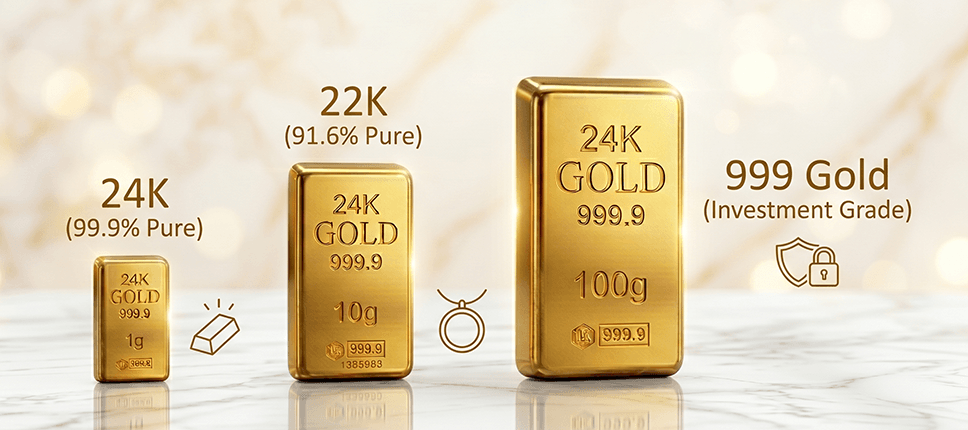
| 24K | 99.9% (999) | Bullion bars and coins; investment-grade gold; not ideal for intricate, daily-wear jewellery due to softness |
| 22K | 91.6% (916) | Traditional and bridal jewellery; high-gold appearance with improved durability over 24K |
| 20K | 83.3% (833) | Designer and heirloom jewellery requiring a balance of purity and strength |
| 18K | 75.0% (750) | Fine jewellery, engagement and wedding rings, gemstone settings; durable for frequent wear |
| 14K | 58.3% (585) | Everyday jewellery with higher scratch resistance and more affordable pricing |
| 10K | 41.7% (417) | Budget-friendly, hard-wearing jewellery; common in markets where 10K is the minimum legal "gold" standard |
One thing worth knowing: for jewellery and artefacts, BIS officially hallmarks six gold carats in India: 14K (585), 18K (750), 20K (833), 22K (916), 23K (958) and 24K (995 fineness, marked 24KS); while 999 refers to investment-grade bullion.
So a 20K vs 22K gold choice is really a trade-off between higher durability and higher gold content, and 10K, though sold in some markets, is not a BIS-hallmarked grade in India.
Understanding the BIS Hallmark for 20-Karat Gold
The easiest and safest method is to check the 20-carat gold hallmark.
The Bureau of Indian Standards (BIS) runs India’s only official hallmarking scheme, and it is backed by the government. Since the six-digit HUID (Hallmark Unique Identification) was introduced on 1 July 2021, a hallmarked gold article carries three marks: the BIS logo (a triangle); the purity in carat and fineness, shown as ‘20K833’ for 20-carat gold; and the six-character alphanumeric HUID.
You may still see older pieces with the earlier four-mark format, which recorded the BIS logo. Purity Mark ('20K' or '833'). Jeweller's Identification Mark. Year Code.
Under the current HUID system, the separate jeweller’s mark and year code are no longer required on newly hallmarked jewellery, because the HUID already links back to the jeweller and the testing centre in the BIS database. Mandatory HUID-based hallmarking has been applied since 1 April 2023, so any newly bought hallmarked gold should carry a HUID.
Hallmarking itself is cheap; BIS charges jewellers ₹45 per gold article, so a missing hallmark is rarely about cost.
When you see '833' stamped on gold, it means 833 gold means the piece is 83.3% pure, exactly 20 carat gold purity percentage. Understanding this helps you avoid scams and ensures you know what you are paying for.
Use the BIS Care app to scan and confirm hallmark details. Always buy from certified jewellers to avoid fraud. If the tested purity is ever found short of what is marked, Rule 49 of the BIS Rules, 2018, entitles the buyer to compensation of twice the shortfall amount plus testing charges.
5 Ways to Check the Purity of 20-Karat Gold
There is no single ‘best’ test; each answers a slightly different question. Here are five gold purity test methods, from the most reliable to the most basic, with what each one can and cannot tell you.
1. BIS Hallmark Verification: The Most Reliable Method
Start here, because it is the only method that gives government-backed proof. Locate the hallmark stamp (usually on the inner surface of a ring or bangle, or near the clasp of a chain), find the ‘833’ fineness number, and note the six-character HUID. Open the BIS CARE app, tap ‘Verify HUID’, and enter the code exactly as stamped; the app returns the registered purity, the jeweller and the testing centre. If the details don’t match the piece in front of you, treat it as a red flag.
2. Magnet Test: A Quick Home Check
Gold is non-magnetic. If your 20K gold jewellery sticks to a magnet, it likely contains non-gold metals. Use a strong neodymium magnet for accuracy. The catch: this only rules out iron- or steel-based fakes. Several base metals used to pad gold, like copper or brass, aren’t magnetic either, so passing the magnet test does not confirm purity.
3. Float Test: Simple Water Check
Place the jewellery in water. Pure gold sinks due to its high density. If it floats or moves unusually, it may be fake or gold-plated. It’s a useful five-second sanity check, but nothing more; it can flag an obvious fake, yet it cannot tell 20K from 22K, and a dense fake can still sink.
4. Density Test: A More Precise Approach
Weigh the jewellery and measure its volume by water displacement. Use the formula: density = weight (grams) / water displacement (cm³). If the density is near 19.3 g/cm³, the gold is likely genuine. Keep in mind that 19.3 g/cm³ is the density of pure (24K) gold. Because 20K is alloyed, its density is lower – roughly 15.5–16.5 g/cm³ (these are standard physical density values, not a government-published figure); so for a 20K piece, expect a reading below 19.3, not equal to it. It needs a precise scale and a little arithmetic, but it is the most accurate check you can do at home.
5. Professional Testing: Acid Test and XRF Analysis
For a definitive answer, professionals use two methods. Apply nitric acid to a small scratch on the gold. No reaction indicates purity, while a colour change suggests impurities. However, this test is best done by professionals due to safety risks. Please don’t try the acid test at home; nitric acid is corrosive and genuinely dangerous to handle.
The second method, X-ray fluorescence (XRF), is non-destructive and highly accurate, which is why jewellers and gold-loan lenders rely on it. For the most accurate result, take the piece to a certified jeweller or a BIS-recognised assaying and hallmarking centre. Avoid home tests like nitric acid unless done by professionals.
Common Gold Scams and How to Protect Yourself
Knowing the tests is only half the battle. These are the tricks to watch for and how to shut them down.
- Fake hallmarks. Beware of fake 20-carat gold hallmark signs. Always verify hallmark details using the BIS Care app. A counterfeit stamp is easy to press; a HUID that doesn’t exist in the BIS database is not, which is why the app check matters.
- Gold-plated jewellery is sold as solid gold. Gold-plated items look real but have only a thin layer of gold. The hallmark '833' helps distinguish genuine 20K gold from plated jewellery. Check the edges and clasps for discolouration or a different colour showing through, as this is where the plating tends to wear first.
- Weight manipulation. Some jewellers use tampered scales to show more weight. Always cross-check weight with a calibrated digital scale. Ask for the piece to be weighed in front of you.
- Inflated making charges. Compare making charges across multiple jewellers. Don’t pay the first price offered without negotiation. High making charges are often used to blur the true gold value, so insist on a proper receipt that lists purity, weight and making charges separately, and buy only from BIS-registered jewellers.
- A couple of habits protect you more than any single test: constantly look for the official 20-carat gold hallmark sign. And, for anything valuable, get the piece assayed at a BIS-recognised centre before you buy or pledge it.
How Gold Purity Affects Value: Loans, Resale, and Investment
Purity isn’t just a technical detail; it drives three financial outcomes:
Gold loans: Lenders advance money against jewellery of accepted purity, and higher purity means a higher value per gram. Under the Reserve Bank of India (Lending Against Gold and Silver Collateral) Directions, 2025, which lenders must follow from 1 April 2026, the loan-to-value (LTV) cap is tiered by loan size: up to 85% for loans up to ₹2.5 lakh, up to 80% for loans above ₹2.5 lakh and up to ₹5 lakh, and up to 75% for loans above ₹5 lakh.
The same rules require lenders to use standardised assaying to check purity and net weight and to value only the metal content (stones and mountings are excluded), and they cap what a single borrower can pledge at 1 kg of gold ornaments; pledged gold must be returned within seven working days of you closing the loan.
- Resale. Because 20K holds less pure gold than 22K or 24K, it fetches a lower price per gram on resale or exchange; the ‘833’ figure is precisely what a buyer uses to work out its worth.
- Investment. For pure investment, 24K coins and bars are the usual choice thanks to their higher purity and easier resale; 20K is more naturally suited to jewellery than to a portfolio.
Before you pledge or sell, it’s worth running the numbers first. A simple gold purity or gold loan calculator lets you enter weight and caratage to estimate the pure gold content and an approximate value, so you know roughly what to expect.
Making a Smart 20-Karat Gold Purchase
Knowing how to check the purity of 20-carat gold is essential for smart purchases. Rely on BIS hallmarks, density tests, and professional verification over DIY methods. Always buy from certified jewellers, and stay alert for fake hallmarks and manipulated scales. With the right knowledge, you ensure authenticity, durability, and good value for your 20K gold investment.
Also Read: 24-Carat Gold Purity Percentage Explained
Frequently Asked Questions
What is the purity percentage of 20-carat gold?
20-carat gold is 83.33% pure gold, worked out as (20 ÷ 24) × 100 = 83.33%. The remaining 16.7% is alloy metals such as copper, silver or zinc, which add strength and durability. In fineness terms, this is written as ‘833’.
What does the ‘833’ hallmark on gold mean?
The ‘833’ hallmark means the gold is 83.3% pure, which corresponds to 20-carat gold. It is part of the BIS hallmarking system, and BIS recognises 833 as one of its official gold fineness grades under IS 1417:2016.
How can I verify a BIS hallmark on 20-carat gold at home?
Download the BIS CARE app, find the six-character HUID stamped on the piece, and enter it under ‘Verify HUID’. The app confirms the registered purity, jeweller and testing centre from the BIS database. It is the most reliable check you can do yourself.
Is 20-carat gold good for investment in India?
It isn’t the usual pick. Indian investors lean towards 22K and 24K, and for pure investment, 24K coins or bars are generally recommended for their higher purity and easier resale. That said, genuine 20K still holds reasonable value at 83.3% purity, especially as jewellery.
Can I check gold purity at home without any equipment?
Partly. The magnet test needs only a magnet; real gold isn’t magnetic, and the float test needs a glass of water, since genuine gold sinks. Both can expose an obvious fake, but neither confirms exact purity. For that, BIS hallmark verification is the reliable route.
How does 20-carat gold differ from 22-carat gold?
20-carat gold is 83.3% pure; 22-carat is 91.6% pure. 22K is the more common choice for Indian jewellery and costs more per gram, while 20K is harder and more durable thanks to extra alloy. In short, 20K trades a little gold content for a little more strength.
What alloys are mixed with 20-carat gold?
The 16.7% that isn’t gold is usually a mix of copper, silver, zinc or occasionally nickel. The exact blend depends on the jeweller and the design; copper warms the colour, while silver and zinc improve workability and strength.
How does gold purity affect a gold loan amount?
Lenders assess purity before fixing the amount, and higher-purity gold supports a higher valuation per gram. Most lenders accept 20K but value it proportionally below 22K or 24K. The final loan also depends on the RBI’s tiered LTV caps of 85%, 80% and 75% by loan size
The information contained herein is generic in nature and is meant for educational purposes only. Nothing here is to be construed as an investment or financial or taxation advice nor to be considered as an invitation or solicitation or advertisement for any financial product. Readers are advised to exercise discretion and should seek independent professional advice prior to making any investment decision in relation to any financial product. Aditya Birla Capital Group is not liable for any decision arising out of the use of this information.
.svg)


.webp)
