
.gif)
.png)
.png)
.svg)
.svg)
.png)
.svg)

- What Are Gold ETFs and Silver ETFs?
- How Gold ETFs Work
- How Silver ETFs Work
- Gold ETF vs Silver ETF: Side-by-Side Comparison
- Returns Comparison: Gold ETF vs Silver ETF in India
- Risk and Volatility: Why Silver ETFs Swing More Than Gold ETFs
- The Gold-Silver Ratio: A Simple Guide for ETF Investors
- Liquidity and Expense Ratios: Practical Costs of Investing
- Tax on Gold ETF and Silver ETF Gains in India
- Which ETF Suits Your Risk Profile?
- Gold and Silver, Without the Trading Account
- Frequently Asked Questions
Gold ETFs and silver ETFs both hold physical metal and trade on Indian exchanges, but they behave very differently: gold moves in steadier steps, while silver swings hard in both directions because half its demand comes from factories rather than investors. This page compares the two on returns, risk, liquidity, expense ratios and tax, so you can pick based on your own risk profile rather than last year's headline numbers.
The short version: gold ETFs offer lower volatility and deeper liquidity on Indian exchanges, which makes them the default for conservative investors. Silver ETFs carry sharper short-term price swings driven by industrial demand cycles but have delivered higher returns in certain bull-market phases. Most investors are better served holding both, with the split set by how much volatility they can live with.
What Are Gold ETFs and Silver ETFs?
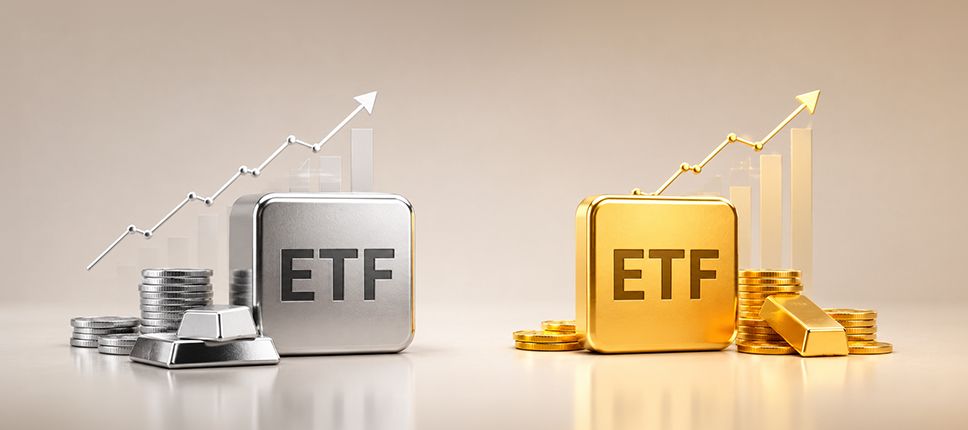
A gold ETF is a mutual fund scheme that holds physical gold of 99.5% purity and lists its units on the NSE and BSE, where they trade like a share through the day. You do not receive the metal. You hold units in your demat account, and each unit represents a small quantity of gold sitting with a custodian appointed by the fund house.
A silver ETF works the same way, one rung down the price scale. SEBI notified the rules for silver ETFs on 9 November 2021. Under those norms, a silver ETF must keep at least 95% of net assets in silver and silver-related instruments, and the physical holding must be in 30 kg bars of 999 fineness, or 99.9% purity.
Both are regulated by SEBI, and both are classified as non-equity mutual fund schemes. Neither pays interest or dividends; your entire return comes from the metal price, minus the fund's running cost.
One change worth knowing about: from 1 April 2026, fund houses value their physical gold and silver using polled spot prices published by recognised Indian stock exchanges. Earlier, they started from the London Bullion Market Association morning fix and adjusted it for currency, freight, customs duty and taxes. The new method ties NAV directly to Indian market conditions and makes schemes easier to compare against each other.
How Gold ETFs Work
When you buy a gold ETF unit, the fund buys an equivalent quantity of physical gold and places it with an authorised custodian. The NAV then tracks the domestic gold spot price less expenses.
Because gold is priced globally in US dollars, the rupee-dollar rate feeds into your return as well. A weaker rupee lifts domestic gold prices even when the international price is flat, which is one reason Indian gold returns have often looked better than dollar-denominated ones.
How Silver ETFs Work
The mechanics are identical: the fund holds silver bars with a custodian, and unit prices follow the domestic silver spot price. The difference sits in what moves that price.
Gold demand is overwhelmingly for investment and jewellery. Silver has a second engine: industrial demand from solar panels, electric vehicles, electronics and medical devices. That means silver ETF returns respond to global manufacturing cycles as well as to the safe-haven flows that drive gold. Supply is tight too: the Silver Institute has reported a sixth consecutive annual supply deficit for 2026, of roughly 67 million ounces. This dual demand is exactly why silver ETF returns and gold ETF returns diverge so sharply across economic cycles.
Gold ETF vs Silver ETF: Side-by-Side Comparison
| Feature | Gold ETF | Silver ETF |
|---|---|---|
| Underlying asset | Physical gold with a custodian | Physical silver with a custodian |
| Purity standard | 99.5% | 99.9% (30 kg bars, 999 fineness) |
| Available in India since | March 2007 | January 2022 |
| Volatility | Moderate | High; roughly twice gold's swing in recent periods |
| Liquidity on NSE | High; the largest schemes trade heavily every day. | Moderate; concentrated in a few large funds |
| Category AUM (end-June 2026) | About ₹1.70 lakh crore | About ₹78,900 crore |
| Investor folios (April 2026) | About 1.24 crore | About 54.57 lakh |
| Expense ratio | Typically under 1% a year; several schemes well below 0.5% | Broadly similar range |
| Tracking error | Capped at 2% under SEBI norms; disclosed by every scheme | Same 2% cap and disclosure requirement |
| Industrial use | Limited | Large and growing |
| Portfolio role | Core defensive holding | Tactical, higher-risk satellite |
| Tax treatment | 12 months for long-term; 12.5% LTCG, slab-rate STCG | Identical |
The single most important difference is this: silver carries higher return potential and higher risk, and both come from the same source. Industrial demand amplifies its price swings in a way gold never experiences.
Returns Comparison: Gold ETF vs Silver ETF in India
Silver ETFs were only launched in India in January 2022, so as of August 2026 the category has no five-year track record at all.
Here is what the underlying metals have actually done in India, which is what both ETF types track before costs:
| Period | Domestic gold | Domestic silver |
|---|---|---|
| Calendar year 2025 | About +75% | About +168% |
| One year to early August 2026 | About +44% | Roughly doubled |
| Month to early August 2026 | About −2.7% | About −8% |
| Price on 3 August 2026 | ₹1,43,890 per 10 g (24K) | ₹2,19,420 per kg (999 fine) |
Gold reached an all-time high of ₹1,69,349 per 10 grams on 2 March 2026 and has traded below that level since. Both metals are well off their peaks as of early August 2026.
Your actual ETF return will sit slightly below the metal's move, because the expense ratio and a small tracking error come out of it.
Also Read: Best Silver ETF India 2026: Complete Guide to Top Funds, Returns & How to Invest
Risk and Volatility: Why Silver ETFs Swing More Than Gold ETFs
Two structural reasons explain silver's bigger swings.
First, the silver market is far smaller than gold's. The same rupee value of buying or selling moves silver's price much further, so flows that gold absorbs quietly can push silver several per cent in a day.
Second, industrial demand adds a whole layer of price sensitivity that gold does not carry. When global manufacturing is expanding – solar installations, EV production, electronics – silver gets bid up by buyers who need the metal, not just by investors hedging risk. When manufacturing slows, that support disappears at the same time investors are heading for the exit.
Gold is not risk-free either. It pays nothing, it can go sideways for years, and it fell in the June–July 2026 correction too. But it fell less, and it recovers with less volatility.
The Gold-Silver Ratio: A Simple Guide for ETF Investors
The gold-silver ratio is simply the gold price divided by the silver price: how many ounces of silver buy one ounce of gold. On 2 August 2026, it stood at about 70. Over the previous 52 weeks it ranged between roughly 46 and 90, and the average of annual readings since 1971 is around 60.5.
Liquidity and Expense Ratios: Practical Costs of Investing
Gold ETFs are the larger and more liquid category by a wide margin. At the end of June 2026, gold ETF assets in India stood at roughly ₹1.70 lakh crore against about ₹78,900 crore for silver ETFs; and gold ETFs counted about 1.24 crore investor folios in April 2026 against 54.57 lakh for silver.
Why that matters: higher daily trading volume means a tighter bid-ask spread, which is the gap between what buyers are offering and what sellers are asking. On a heavily traded gold ETF, that gap is a few paise. On a thinly traded silver ETF, it can cost you a noticeable slice of your return on the way in and again on the way out.
So before you pick a silver ETF, check two things on the exchange website: the scheme's AUM and its average daily traded volume. A large silver ETF from a major fund house will usually cost you far less to trade than a small one, even if the smaller fund advertises a lower expense ratio.
On costs, most Indian gold and silver ETFs charge under 1% a year, with several well below 0.5%. Expense ratios change, so confirm the current figure in the scheme information document or the fund's factsheet rather than relying on a comparison article. Beyond that, your only costs are broking and the usual exchange charges; note that securities transaction tax does not apply to gold and silver ETF trades.
Tax on Gold ETF and Silver ETF Gains in India
Both gold ETFs and silver ETFs are listed as non-equity schemes. Units held for more than 12 months produce long-term capital gains, taxed at a flat 12.5% without indexation, plus surcharge and cess as applicable. Units held for 12 months or less produce short-term capital gains, added to your total income and taxed at your slab rate.
The ₹1.25 lakh annual long-term exemption applies to listed equity and equity-oriented funds. It does not apply to gold or silver ETFs.
An unlisted gold or silver fund-of-funds is a different product with a different holding period, so check whether you hold a listed ETF before applying these rules.
Which ETF Suits Your Risk Profile?
Both ETFs sit in the same demat account and buy the same way, so the only real decision is the split. Precious metals are usually a slice of a portfolio rather than the whole thing; a 5% to 15% allocation is a common range, and the gold-silver split happens inside that slice.
Conservative investor. Lead with gold. Its lower volatility and long record as a store of value are the point of owning metal in the first place. Something like a 70-80% gold ETF and a 20-30% silver ETF within the metals allocation is a common starting point.
Moderate investor. A 50-50 split gives you gold's steadiness alongside silver's industrial upside, and it rebalances naturally; you trim silver after it runs and top it up after it falls.
Aggressive investor. A silver weight of 50-60% may suit someone who genuinely does not mind a 30% drawdown and wants exposure to manufacturing-led demand.
These are illustrative ranges, not personalised advice. If a large sum is involved, speak to a SEBI-registered investment adviser who can look at your full portfolio.
Also Read: Digital Silver vs Silver ETF: Key Differences, Tax Treatment, and Which Suits You
Gold and Silver, Without the Trading Account
Gold and Silver ETFs offer exposure to precious metals without physically buying the asset, but it cannot be done without a demat account. If you wish to start without one, Digital Gold and Digital Silver offer a hassle free and easy option. Buy small quantities of 24K999.9% gold or 999.9+ pure silver, with the physical asset stored in secured vaults rather than at home. With Aditya Birla Capital, you can access both options through the ABCD app, making it convenient to purchase the metal of your choice from the comfort of your smartphone.
Frequently Asked Questions
Is it better to invest in a gold or silver ETF?
It depends on your risk appetite. Gold ETFs suit conservative investors who want a steadier inflation hedge with deep liquidity on the NSE. Silver ETFs suit investors willing to accept much sharper price swings in exchange for exposure to industrial demand. A blended allocation covering both is the common approach for moderate investors.
What are the disadvantages of a silver ETF?
There are mainly three main disadvantages.
- Trading volumes are lower than gold ETFs, so bid-ask spreads can be wider and entry or exit costlier.
- Silver prices are more volatile because industrial demand adds a second layer of sensitivity.
- And silver ETFs have only existed in India since January 2022, so there is no long track record to judge them by.
How is tax calculated on gold ETF and silver ETF gains in India?
Both are listed as non-equity schemes. Units held more than 12 months attract long-term capital gains tax at 12.5% without indexation, plus surcharge and cess. Units held 12 months or less are taxed at your income slab rate. The ₹1.25 lakh equity exemption does not apply.
Which ETF is more volatile, gold or silver?
Silver, clearly. It responds to investment demand like gold and to industrial demand from electronics, solar and EV manufacturing.
Can gold ETFs and silver ETFs be held in the same demat account?
Yes. Both are listed on the NSE and BSE and can be bought, sold and held in a standard demat and trading account, the same one you use for shares. No separate account type or regulatory permission is needed for either.
The information contained herein is generic in nature and is meant for educational purposes only. Nothing here is to be construed as an investment or financial or taxation advice nor to be considered as an invitation or solicitation or advertisement for any financial product. Readers are advised to exercise discretion and should seek independent professional advice prior to making any investment decision in relation to any financial product. Aditya Birla Capital Group is not liable for any decision arising out of the use of this information.
.svg)


.webp)
