
.gif)
.png)
.png)
.svg)
.svg)
.png)
.svg)

- What Is Silver Purity and How Is It Measured?
- 999 Fine Silver: The Purest Grade
- 925 Sterling Silver: Why It Is the Jewellery Standard
- 958 Britannia Silver: The High-Purity Alloy
- 800 Silver: The European Standard Explained
- Lesser-Known Grades: 900 Coin Silver and 700 Silver
- How to Read Silver Hallmarks and BIS Codes in India
- Can 925 Silver Be Fake? Spotting Counterfeit Hallmarks
- Silver Purity and Value: Price, Resale, and Investment Considerations
- Choose High-Purity Silver Without the Storage Hassle
- FAQS – FREQUENTLY ASKED QUESTIONS
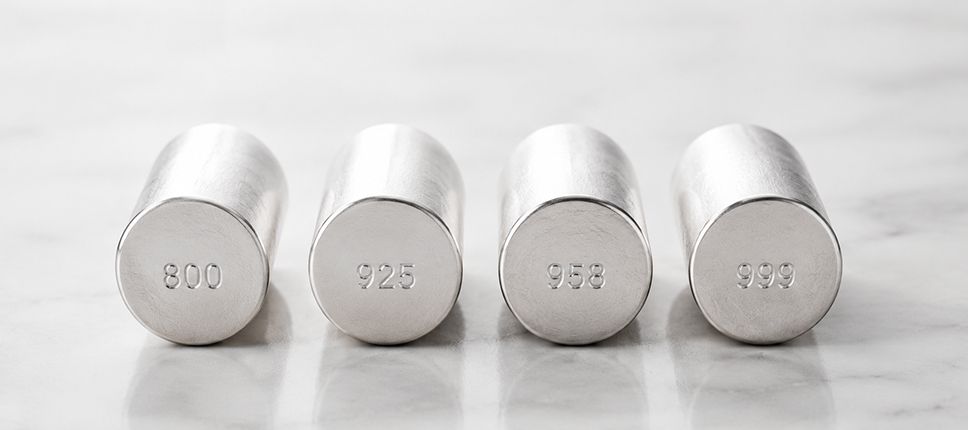
The millesimal fineness of silver is a three-digit number that shows how much pure silver is in every 1,000 parts of alloy. Indian buyers care most about four grades: 999 (99.9% pure, used for investment bars and coins), 958 (95.8% pure, better Britannia cutlery), 925 (92.5% pure, the standard for jewellery around the world) and 800 (80% pure, older European cutlery). Each grade trades the amount of silver for strength, price, and resistance to tarnishing. This means that the "purest" option isn't always the best one.
The table below is a quick reference before the detailed breakdown of each grade.
| Grade | Silver % | Common Name | Typical Use |
|---|---|---|---|
| 999 | 99.9% | Fine silver | Investment bars, coins, silver ETFs |
| 970 | 97.0% | High-purity alloy | Premium bullion coins |
| 958 | 95.8% | Britannia silver | Premium silverware |
| 925 | 92.5% | Sterling silver | Jewellery - rings, chains, everyday wear |
| 900 | 90.0% | Coin silver | Historic and collectible coins |
| 835 | 83.5% | Continental alloy | Older European silverware |
| 800 | 80.0% | European silver | Antique or imported silverware |
| 700 | 70.0% | No standard name | Antique items, some industrial parts |
What Is Silver Purity and How Is It Measured?
Millesimal fineness expresses purity as parts of pure silver per 1,000 parts of metal by weight. A piece stamped 925 contains 925 parts silver and 75 parts other metal - the silver purity percentage is simply the fineness number divided by ten. Pure silver (999) is soft enough to dent or scratch under ordinary handling, so almost nothing is made from it in that state. Alloying fixes this the way mixing sand into wet clay makes it firm enough to hold a shape: a small amount of a harder material changes how the mixture behaves without changing what it fundamentally is. Copper is the alloying metal used across nearly every grade because it is inexpensive, blends closely in colour with silver, and raises hardness sharply even in small proportions. The different types of silver purity - 999, 958, 925, 900 and 800 among them - are essentially different copper ratios applied to the same base metal.
999 Fine Silver: The Purest Grade
999 silver is 99.9% pure, with only trace impurities making up the remainder. It is the grade used for investment bullion bars, silver coins, and the silver ETFs and mutual funds tracked by Indian investors, rather than for jewellery. At this purity, silver is too soft to hold a ring or chain shape reliably and scratches with light contact, which rules it out for daily wear. Because it carries no alloy dilution, 999 commands the highest melt value of any grade and trades closest to the spot silver price - a premium that matters to investors comparing bars against jewellery-grade metal. Under the revised BIS hallmarking standard (IS 2112:2025), 999 is one of the recognised purity marks for hallmarked silver in India, alongside a newly added 958 grade. For anyone buying silver purely as an investment, 999 is the benchmark grade: it is what silver ETFs, sovereign coins, and most bullion dealers price against, so it offers the most direct exposure to the silver price itself.
925 Sterling Silver: Why It Is the Jewellery Standard
925 sterling silver is 92.5% pure silver alloyed with 7.5% copper, and it is the standard against which most fine jewellery is made worldwide. The copper addition roughly doubles the metal's hardness (measured on the Vickers scale) compared with pure silver, without materially changing its bright white colour or its resistance to tarnish at this ratio. So, is silver 925 good quality? Yes - it is the internationally recognised benchmark for jewellery, striking a workable balance between purity, durability and cost, and it is what most rings, chains and bracelets sold in India are made from. A related question buyers ask is why 925 silver costs less than 999: the answer is that 7.5% of its weight is non-precious copper rather than silver, and it is produced at jewellery-manufacturing scale rather than bullion scale. The price gap between the two grades reflects that lower silver content plus the cost structure of mass production, not a difference in how genuine or well-made the piece is. Under India's revised silver hallmarking standard (IS 2112:2025), 925 remains one of the recognised purity grades, now paired with a unique HUID code on any piece a jeweller chooses to hallmark. This combination of durability, familiarity and manageable cost is exactly why sterling silver dominates jewellery counters in India over higher grades: a 925 chain can be worn daily for years without the shape distortion or heavy scratching that a softer, higher-purity piece would show over the same period.
958 Britannia Silver: The High-Purity Alloy
958 Britannia silver is 95.84% pure silver alloyed with 4.16% copper, placing it between sterling (925) and fine silver (999) in both purity and hardness. The standard originated in Britain in 1697, when it briefly replaced sterling as the mandatory grade for English silverware to deter coin-clipping, and it has since remained in use for premium silverware and select hallmarked British coins. Because it carries less copper than 925, Britannia silver is softer and more prone to denting, but it also carries more silver by weight, giving it a higher melt value. It is uncommon in Indian jewellery but can appear in imported silverware or high-end tableware. Following the September 2025 revision to India's silver hallmarking standard (IS 2112:2025), 958 was added as a newly recognised BIS purity grade, alongside 999 - a change that reflects growing demand for higher-purity silver articles in the Indian market.
Also Read: 925 Silver Meaning: What Is Sterling Silver and How Pure Is It?
800 Silver: The European Standard Explained
What is 80% silver called? It is known as 800 silver or European silver - 80% pure silver alloyed with 20% base metal, almost always copper. The 800 standard was widely used across Continental Europe for silverware, cutlery and some older coinage, particularly in Germany, Austria and France, where it served a role similar to what sterling silver plays in Britain and India. Because it carries more than double the copper content of 925, 800 silver tarnishes noticeably faster and needs more frequent polishing to stay bright. It is not a grade used for new jewellery manufacturing in India, so most 800-marked pieces found here are either imported antiques or inherited European silverware rather than current-production items. Buyers who come across an 800 stamp on an old piece can treat it as a genuine, if lower-purity, silver mark rather than a defect - it simply reflects a different national standard, not counterfeit or low-quality metal.
Lesser-Known Grades: 900 Coin Silver and 700 Silver
900 fineness, known as coin silver, is 90% pure silver historically used by several countries, including the United States before 1965, for government-minted circulating coins. It survives today mainly in older collectible and numismatic coins rather than in current jewellery or bullion production. A separate question buyers sometimes ask is what 70 purity silver is: 700 fineness contains 70% silver and 30% base metal, and unlike 800 or 900, it has no widely recognised commercial name. It surfaces occasionally in antique items or certain industrial components, but it is not a standard used for jewellery or investment anywhere, including India. Neither 900 nor 700 features among the seven purity grades recognised under India's current silver hallmarking standard, IS 2112:2025 - which lists 800, 835, 925, 958, 970, 990 and 999 - so buyers evaluating new purchases in India are unlikely to encounter either grade outside antique or collectible contexts.
How to Read Silver Hallmarks and BIS Codes in India
Silver hallmarking in India is currently voluntary - unlike gold, where hallmarking is compulsory - but any silver article a jeweller does choose to hallmark must comply with the revised IS 2112:2025 standard, effective from September 2025. A compliant hallmark carries three elements: the BIS Standard Mark with the word "SILVER," the purity grade number, and a unique six-digit alphanumeric HUID (Hallmark Unique Identification) code.
| Grade | BIS Code Shown | Silver % |
|---|---|---|
| 999 | 999 | 99.9% |
| 990 | 990 | 99.0% |
| 970 | 970 | 97.0% |
| 958 | 958 | 95.8% |
| 925 | 925 | 92.5% |
| 835 | 835 | 83.5% |
| 800 | 800 | 80.0% |
How to identify 100% silver: look for a 999 stamp or "FS" (fine silver) marking. In India, an HUID-backed BIS hallmark under IS 2112:2025 is the strongest available assurance, since it can be verified through the BIS CARE mobile app by entering the six-digit code printed on the piece - the app returns the article type, purity grade, hallmarking date and the registered jeweller's details, and flags an invalid or missing code immediately. Beyond the hallmark, two quick at-home checks add confidence, though neither replaces a verified stamp: the magnet test (genuine silver is non-magnetic, so a magnet should not pull at it) and the ice-melt test (silver's unusually high thermal conductivity makes ice melt noticeably faster on it than on most other metals, including many look-alike alloys).
Can 925 Silver Be Fake? Spotting Counterfeit Hallmarks
Yes - items stamped 925 can be silver-plated base metal, or can carry a fraudulent hallmark altogether, since a stamp alone does not guarantee purity unless it can be independently verified. Counterfeiting typically works by plating a low-value base metal with a thin layer of real silver and stamping "925" on the surface, so the mark looks correct to the eye even though the bulk of the item is not silver at all. A few checks help separate genuine pieces from fakes: a nitric acid test, done by a professional, turns base metal green while genuine silver develops a creamy residue; tarnish or discolouration appearing specifically on worn edges suggests the plating has rubbed through; and an unusually low price relative to the current silver rate is itself a warning sign. The most reliable safeguard is buying only from BIS-hallmarked or otherwise certified sellers and verifying the HUID code through the BIS CARE app before completing a purchase, since a genuine, verifiable HUID gives legal backing that a printed "925" stamp on its own does not.
Silver Purity and Value: Price, Resale, and Investment Considerations
Purity percentage translates directly into price per gram, because buyers are ultimately paying for the silver content, not the alloy as a whole. A 999 bar commands a higher price per gram than 925 jewellery of the same weight, since it contains more actual silver. As an illustration, with silver trading at roughly ₹230–235 per gram in India in mid-2026, a 10-gram item in 925 purity contains about 9.25 grams of pure silver, while the same weight in 999 purity contains 9.99 grams - a difference that shows up directly in resale value and, for those pledging silver, in collateral value as well. This is also why purity matters when selling old silver back to a jeweller or refiner: they pay against the actual silver content after adjusting for the grade, not the gross weight of the piece. For investment purposes, 999 grade is generally preferred because it tracks the spot silver price most closely, while 925 remains the standard for jewellery, where workability and durability matter alongside precious-metal content. Silver ETFs and silver mutual funds available in India are built on 999-grade silver, giving investors a purity-transparent route into the metal without needing to verify hallmarks or store physical bars themselves.
Choose High-Purity Silver Without the Storage Hassle
Silver purity matters: while 925 silver is commonly used for jewellery, 999 silver is generally preferred when buying coins or bars for investment. But owning high-purity silver doesn't necessarily mean buying and storing physical bars or coins. With Digital Silver from Aditya Birla Capital, you can buy 999.9+ pure silver starting from ₹10 through the ABCD app, making it possible to start buying silver in small amounts. Your silver is stored in insured vaults, while you can sell it digitally or opt for physical redemption, subject to applicable terms and charges.
Also Read: 999 Fine Silver: What the Purity Mark Means and Why It Matters
FAQS – FREQUENTLY ASKED QUESTIONS
What is 70 purity silver?
70% silver (700 fineness) is a low-grade alloy containing 70% silver and 30% base metals. It has no widely recognised commercial name and is not a standard used for jewellery or investment bullion. It may appear in some antique items or industrial components. For jewellery or investment in India, grades of 925 or above are recommended.
Is silver 925 good quality?
Yes. 925 sterling silver is 92.5% pure silver alloyed with 7.5% copper for added strength. It is the internationally recognised standard for fine silver jewellery, balancing purity, durability, and affordability. It is suitable for rings, necklaces, and other everyday jewellery items.
What is 80% silver called?
80% silver (800 fineness) is called 800 silver or European silver. It was widely used in Continental European silverware and some older coins. It contains 20% base metal, usually copper, which makes it more prone to tarnishing than 925 or 999 silver. It is not a common standard for new jewellery in India.
How to identify 100% silver?
Look for a 999 or FS (fine silver) hallmark stamp. In India, a BIS hallmark under the revised IS 2112:2025 standard, verified via the BIS CARE app using its HUID code, confirms purity for pieces that carry it. At-home tests include the magnet test (genuine silver is non-magnetic) and the ice-melt test (silver's high thermal conductivity causes ice to melt faster on contact).
Can 925 silver be fake?
Yes. Items stamped 925 can be silver-plated base metal with a fraudulent hallmark. Signs of fake 925 include tarnish or discolouration on worn edges where plating has worn off, a green tinge under a professional acid test, and an unusually low price. Buy from BIS-hallmarked sellers in India and verify the HUID code to confirm authenticity.
Why is 925 silver cheaper than 999 silver?
925 silver contains 7.5% copper instead of pure silver, reducing the raw material cost, and it is mass-produced for the jewellery market. The price difference reflects the 7.5% lower silver content plus manufacturing scale. For investment purposes, 999 fine silver commands a higher price per gram because it has a higher melt value.
What are the main silver purity grades and their percentages?
The main grades recognised under India's revised BIS standard (IS 2112:2025) are: 999 (99.9% - fine silver, investment bullion), 970 (97.0%), 958 (95.8% - Britannia silver, premium silverware), 925 (92.5% - sterling silver, the jewellery standard), 835 (83.5%), and 800 (80% - European silver, older Continental silverware). Older, non-BIS-listed grades such as 900 (coin silver) and 700 still appear in antique or collectible items. A higher number always means higher silver content and purity.
The information contained herein is generic in nature and is meant for educational purposes only. Nothing here is to be construed as an investment or financial or taxation advice nor to be considered as an invitation or solicitation or advertisement for any financial product. Readers are advised to exercise discretion and should seek independent professional advice prior to making any investment decision in relation to any financial product. Aditya Birla Capital Group is not liable for any decision arising out of the use of this information.
.svg)


.webp)
