
.gif)
.png)
.png)
.svg)
.svg)
.png)
.svg)

- What Is Silver Purity and Why Does It Matter?
- How to Read BIS Hallmarks in India
- Quick Home Tests to Check Silver Purity Without Equipment
- Chemical Tests for More Accurate Silver Purity Verification
- Professional Tests: When to Go to a Jeweller or Assay Centre
- Silver Purity and Its Impact on Value: What Investors Should Know
- How to Spot Silver-Plated Items vs. Real Silver
- Frequently Asked Questions About Silver Purity
Checking silver purity starts with the hallmark stamp, but not every piece you own or come across will have one, which is where a handful of simple tests come in. This guide covers how to read a hallmark, seven ways to test silver - most needing no special equipment - and what the common purity grades (999, 925, 800) actually mean for value and durability.
Some of these tests you can run in your kitchen in under a minute. Others involve chemicals or professional equipment and are better reserved for higher-value pieces. By the end of this guide, you will know which method fits your specific situation.
What Is Silver Purity and Why Does It Matter?
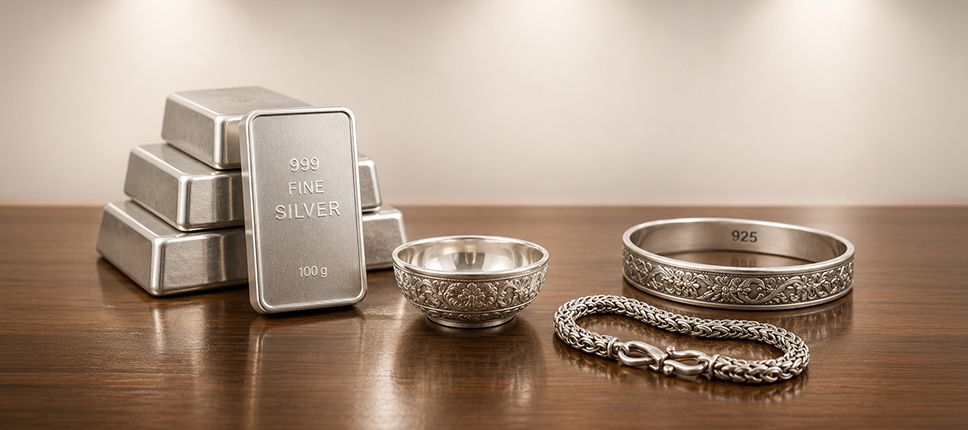
Silver purity is the percentage of pure silver in an item, expressed using millesimal fineness - parts per thousand. A 999 mark means 99.9% pure silver; a 925 mark means 92.5% pure silver, with the remainder made up of other metals.
Pure (100%) silver is very soft, which makes it impractical for most jewellery - it scratches, bends, and wears down quickly under regular use. To solve this, manufacturers alloy silver with copper or other metals, trading a small amount of purity for meaningfully better durability. This is why almost no jewellery on the market is 999 fine silver.
| Grade | Purity | Common Name | Typical Use |
|---|---|---|---|
| 999 | 99.9% | Fine Silver | Investment bars, coins |
| 958 | 95.8% | Britannia Silver | Fine flatware, some jewellery |
| 925 | 92.5% | Sterling Silver | Standard jewellery |
| 900 | 90.0% | Coin Silver | Historical coins, artefacts |
| 800 | 80.0% | European Silver | Older or imported jewellery |
Purity directly affects three things that matter to a buyer: price per gram, how well the item withstands daily wear, and what you can expect to get back if you resell or pledge it later. A jeweller or lender will always price silver based on verified purity, not the number stamped on it - which is exactly why knowing how to check that number yourself matters.
Step 1 - Read the Hallmark: The Most Reliable Method
A hallmark stamp is the single most trustworthy indicator of silver purity, because unlike a home test, it reflects a purity claim the manufacturer or an assay centre has put their name behind.
The simplest version is a plain numeric stamp - "999," "925," or "800" - indicating the fineness grade. On jewellery, look for this stamp on the clasp, the inner band of a ring or bangle, or the underside of a pendant. On coins and bars, it typically appears on the flat face alongside the weight and manufacturer's mark. A magnifying glass helps for small or worn stamps.
In India, the more rigorous version is the BIS hallmark, issued by the Bureau of Indian Standards after testing at an accredited assay centre. A genuine BIS hallmark carries more assurance than a plain manufacturer's number, since it has been independently verified rather than self-declared. Items with no mark at all - no numeric stamp and no BIS hallmark - should be treated with more caution, and are a good candidate for one of the home tests covered further below before you rely on a seller's word alone.
How to Read BIS Hallmarks in India
A full BIS hallmark on silver carries several distinct components, and knowing what each one means helps you read a stamp correctly rather than just glancing at a number. The five parts are: the BIS logo (a small triangular mark), the purity or fineness grade (such as "925"), the assay and hallmarking centre's identification mark, the year of marking, and the jeweller's own identification mark.
Since September 2025, silver hallmarking in India has moved to a newer Hallmark Unique Identification (HUID) system, similar to the one already used for gold jewellery, which has required a HUID since April 2023. Under the silver system, a genuine hallmark carries a unique six-character alphanumeric HUID code specific to that exact item. As of now, silver hallmarking under this HUID system remains a voluntary rollout rather than a blanket requirement on every seller, so the presence of a HUID is a strong positive signal, but its absence does not automatically mean an item is fake - it may simply predate or fall outside the current phase of the rollout. Where a HUID is present, you can verify it through the BIS CARE app or the BIS website by entering the code, which returns the registered jeweller, the certified purity grade, and the assay centre that tested it.
Quick Home Tests to Check Silver Purity Without Equipment
Four tests below need little to no special equipment and can be done at home in a few minutes. None is fully conclusive on its own - combining two or more gives a far more reliable read than relying on a single test.
Magnet Test
Silver is not magnetic, which makes this the fastest first check for an item you suspect might be fake. Hold a strong magnet close to the item - a standard fridge magnet is usually too weak, so a small neodymium magnet works better. If the item sticks firmly or is pulled strongly toward the magnet, it is not pure silver, since iron or steel content is the likely cause.
The limitation is that this test only rules out magnetic base metals. Items with a non-magnetic copper or brass core, such as some silver-plated pieces, will also pass the magnet test without being genuine silver. Reliability: medium - useful as a first filter, but always pair it with a second test before drawing a conclusion.
Ice Test
Silver has the highest thermal conductivity of any metal, which means it pulls heat away from an ice cube unusually fast. Place a small ice cube directly on the item and watch closely - genuine solid silver should cause the ice to begin melting almost immediately, noticeably faster than the same ice cube would melt on a glass or plastic surface placed alongside it for comparison.
This test works best on solid metal items with reasonable mass, such as bars, coins, or thicker jewellery pieces. Reliability: medium-high for solid silver items, but it becomes less dependable on thin silver-plated pieces, since a thin surface layer does not carry heat the way solid silver does.
Ping Test
Balance the item carefully on a fingertip and gently tap its edge with a coin or another small metal object. Genuine silver produces a clear, high-pitched, bell-like ring that continues for roughly one to two seconds after the tap. Base metals, by contrast, tend to produce a duller, shorter thud with none of that ringing quality.
If your ear is not confident judging the sound, a few free smartphone apps can analyse the audio frequency of the tap and give a more objective read. Reliability: medium - this test works best on coins and bars with a simple, uninterrupted shape, and is considerably less reliable on jewellery with gemstone settings or intricate detailing, which dampens the ring.
Smell Test
Genuine silver has essentially no metallic odour, even after handling it for a while. A distinct metallic or "coiny" smell on an item claimed to be silver often points to base metal content, such as copper or nickel, reacting with skin oils and moisture. This test is quick but subjective, and it works better as a supporting signal alongside the other tests rather than as a standalone check.
Also Read: Types of Silver Explained
Chemical Tests for More Accurate Silver Purity Verification
For situations where you want more certainty than the no-equipment tests provide, two chemical tests are commonly used - both of which come with safety considerations worth taking seriously.
1. Bleach test
Apply a single small drop of ordinary household bleach to an inconspicuous spot on the item, such as the underside or an edge that will not be visible in everyday use. Genuine silver reacts to the chlorine in bleach by tarnishing - turning black - within a few seconds to a minute. An item that shows little or no reaction is likely not genuine silver, or has a very thin silver layer. Wipe the bleach off immediately afterward with a clean cloth to prevent any lasting damage to the surface.
2. Acid test (nitric acid)
Nitric acid testing kits are sold at jewellery supply stores and are commonly used by jewellers themselves. The typical method involves making a small, inconspicuous scratch on the item and applying a drop of acid directly to that scratch. Genuine silver produces a distinctive creamy-white reaction, while base metals typically show green or other colour reactions instead.
This test carries real safety considerations: nitric acid is corrosive and should only be handled while wearing gloves and eye protection, in a well-ventilated area, away from children and pets. It will also leave a small, permanent mark on the item, so this method is best reserved for pieces where you are willing to accept minor, localised surface damage in exchange for a clearer answer - and it is generally safer, and often just as effective, to have a jeweller run this test for you rather than attempting it yourself at home.
Professional Tests: When to Go to a Jeweller or Assay Centre
For higher-value purchases - silver bars, coins, or a significant jewellery investment - professional testing is worth the modest cost, since it removes almost all guesswork.
- XRF (X-ray fluorescence) spectrometry is a non-destructive method that gives an exact purity percentage within seconds, without leaving any mark or damage on the item. It is available at many certified jewellers and dedicated assay centres, and it is generally considered the fastest way to get a precise, trustworthy purity reading without risking the item itself.
- Specific gravity testing measures an item's density against the known density of pure silver, which is 10.49 grams per cubic centimetre. A jeweller can perform this test using a precision scale and a container of water, weighing the item both in air and submerged, then calculating density from the difference - a method rooted in basic physics rather than any chemical reaction.
- BIS-certified assay centres offer the most formal route: you can submit an item directly to a BIS-approved assaying and hallmarking centre and receive an official purity certificate in return. This is particularly relevant for investors buying silver bars or coins, where even a small purity discrepancy can meaningfully affect value, and where a documented certificate matters if you ever need to prove authenticity later.
Silver Purity and Its Impact on Value: What Investors Should Know
Purity is not just a technical detail - it has a direct, quantifiable effect on what your silver is worth.
999 fine silver commands the highest price per gram of any grade, since investment-grade bars and coins are valued almost entirely on their metal content. 925 sterling silver, the jewellery standard, carries a lower melt value than 999 silver of the same weight, because 7.5% of its mass is non-silver alloy rather than metal that counts toward resale value.
This distinction matters directly when you go to sell or pledge silver. A buyer or lender calculates the offer based on verified purity, not the number stamped on the item - an unverified or dubious hallmark can mean a lower offer, or a request to retest the item before any transaction proceeds. This is precisely why asking for a purity certificate or a genuine BIS hallmark certificate at the time of purchase protects you later, whether you plan to resell, pledge, or simply pass the item down.
It is also worth noting that digital or paper-based silver investment products - such as those offered through regulated financial platforms - sidestep physical purity testing entirely, since the underlying silver is held in certified vaults and its purity is verified at the institutional level rather than left to the individual buyer to check.
How to Spot Silver-Plated Items vs. Real Silver
Silver-plated items carry a thin layer of genuine silver bonded over a base metal core, usually copper or brass, and distinguishing plated from solid silver comes down to a few visible clues.
- Wear marks: Look closely at edges, clasps, and other high-contact points where an item rubs against skin or clothing. On a plated piece, the thin silver layer often wears through at exactly these points first, revealing a different-coloured base metal underneath.
- Markings: Plated items are frequently stamped "EPNS" (electroplated nickel silver), "SP" (silver plate), or carry no purity mark at all - a genuine solid-silver hallmark like "925" or "999" is a strong signal against plating, though its complete absence does not automatically confirm plating either.
- Polish test: Rub a plain white cloth firmly against the item. Black marks transferring onto the cloth generally indicate genuine silver tarnishing normally. Coloured marks - green, brown, or another shade - can indicate a base metal showing through a worn plated layer.
- Weight: Solid silver is noticeably heavier than a plated item of the same size and shape, since the base metal core in a plated piece is typically lighter than an equivalent volume of silver. Comparing two similar-looking pieces by hand, when possible, often makes this difference obvious.
Looking to purchase silver while avoiding the hassle of checking purity? Digital Silver from Aditya Birla Capital allows you to invest in silver from your smartphone, without having to worry about insurance, security or purity.
Also Read: 999 Fine Silver: What the Purity Mark Means
Frequently Asked Questions About Silver Purity
What does 925 mean on silver?
925 means the item is sterling silver - 92.5% pure silver and 7.5% other metals, usually copper. This is the most common grade for jewellery in India and is considered good-quality silver for everyday wear.
Can I check silver purity at home without chemicals?
Yes. The magnet test, ice test, and ping test require no chemicals. The magnet test is the quickest - real silver is not attracted to a magnet. Combining two or more tests gives a more reliable result than relying on any single one.
What is the difference between 999 and 925 silver?
999 silver is 99.9% pure and is used for investment bars and coins. 925 sterling silver is 92.5% pure and alloyed for durability, making it the standard for jewellery. 999 silver has a higher melt value but is softer.
How do I verify silver purity online in India?
Download the BIS CARE app. Scan or enter the six-character HUID printed on the hallmark of a hallmarked silver item. The app confirms the purity grade, assay centre, and jeweller details, though not every item will carry a HUID yet given the phased rollout.
Is silver-plated jewellery worth buying?
Silver-plated jewellery is affordable but has a thin silver layer over a base metal. It tarnishes faster and has minimal resale value. For everyday wear it is fine, but for investment or gifting, opt for BIS-hallmarked 925 or 999 silver instead.
The information contained herein is generic in nature and is meant for educational purposes only. Nothing here is to be construed as an investment or financial or taxation advice nor to be considered as an invitation or solicitation or advertisement for any financial product. Readers are advised to exercise discretion and should seek independent professional advice prior to making any investment decision in relation to any financial product. Aditya Birla Capital Group is not liable for any decision arising out of the use of this information.
.svg)


.webp)
