
.gif)
.png)
.png)
.svg)
.svg)
.png)
.svg)

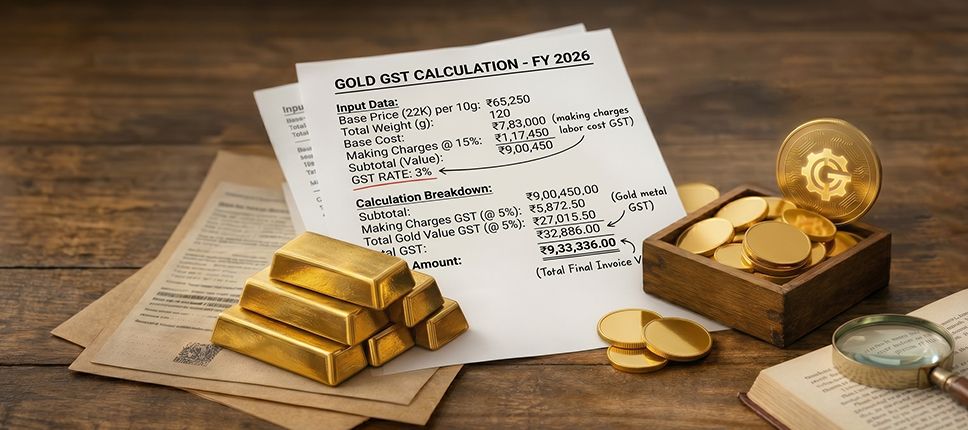
Key Highlights:
- Indian gold is subject to a 3% GST on its original value and a 5% GST on making charges for gold.
- When you buy gold jewellery, coins, or bullion, you usually pay the same GST rate.
- Knowing how GST on gold works can help buyers plan their investments better and be aware of the actual costs.
GST on exchange of gold jewellery or sale of gold can significantly impact the total cost of your investment. Indians have a strong connection with gold but are also calculative when it comes to saving for the future. The inclusion of GST in 2017 eliminated VAT and service tax on gold. It made it easy for buyers to understand the value of their commodity. The following guide will shed some light on the different types of charges applicable when buying, selling, and exchanging gold. Read on to find out more.
GST Rules for Selling or Exchanging Gold in India
When individuals sell old gold or exchange it for new jewellery, the GST rules can sometimes be confusing. In most cases, GST is not directly charged when a person sells old gold, but it does apply when new jewellery is purchased or sold by jewellers. The table below explains how GST works in both situations.
| Transaction Type | How the Transaction Works | GST Applicability |
| Selling old gold to a jeweller | An individual sells old gold jewellery, coins, or ornaments to a jeweller or gold buyer. | GST is usually not charged to the individual seller. The jeweller may later apply GST when the refined gold is sold as new jewellery or bullion. |
| Sale of gold between dealers or wholesalers | Registered gold dealers or wholesalers trade gold among themselves as part of business operations. | GST may apply because these are registered business transactions under GST rules. |
| GST on old gold exchange for new gold | A customer gives old gold to the jeweller and purchases new jewellery in return. The value of the old gold is deducted from the price of the new item. | GST is applied on the full value of the new jewellery, not just the price difference. |
| GST on gold value in new jewellery | The jeweller calculates the value of gold used in the new jewellery. | 3% GST is charged on the value of the gold. |
| GST on making charges | Jewellers charge labour or design fees for creating jewellery. | 5% GST is charged on the making charges. |
| Tax responsibility | The jeweller processes and sells the gold again as a business transaction. | The jeweller or registered business is responsible for GST, not the individual seller. |
To summarise the above table, individuals generally do not pay GST on the sale of gold; however, it is applied when new jewellery is purchased or when businesses trade gold. Buyers should also remember that profits from selling gold investments may be subject to capital gains tax under income tax rules.
Also Read: Will Gold Rate Decrease?
GST on Various Types of Gold
GST charges may be a little different for different types of gold, especially if making charges are included.
| Kind of Gold | GST Rate |
| Gold Jewellery | 3% of the gold's value plus 5% of the cost of making it |
| Gold Coins | 3% |
| Gold bars and coins | 3% |
| Gold ETFs | Not subject to GST (treated as money tools) |
Gold ETFs and other similar financial instruments trade on stock markets, exempting them from GST like gold purchases.
How GST changed the way Indians buy gold
GST on selling gold or buying the commodity was subject to a number of different taxes that varied by state. Buyers had to pay taxes on things like:
- Value-Added Tax
- Tax on services
- Tax on goods
These charges often made it harder for customers to understand the total costs. However, the introduction of GST has made prices more consistent and easier for both jewellers and customers to deal with gold.
Also Read: 1 Bhori Gold in Grams - Conversion, Price & Buying Guide?
How to Buy Gold Under GST
Here are some easy tips that can help people figure out how much gold really costs:
1. Always make sure you get a correct GST bill
A GST statement makes things clear and shows how much tax was paid on the transaction.
2. Analyse Making Charges
Different jewellers may impose varying making fees, which subsequently add 5% GST to the total price.
3. Ask for a purity certificate
Make sure the gold is hallmarked by the BIS. This proves that the jewellery is both pure and real.
4. Consider digital choices
Extra costs, like making charges, may go down if you invest in digital gold, gold ETFs, or sovereign gold bonds.
GST on gold explained for jewellery buyers and sellers
Understanding GST on gold, including the exchange, buying, and selling of the commodity, is crucial for anyone who wants to deal in precious metals in India. Currently, there is a 3% GST charge for the value of the metal and a 5% GST charge for the cost of making jewellery out of gold.
People don't have to pay GST when they sell old gold, but they do have to pay it when they trade it for new jewellery. Compared to older systems, the GST has made it easier to tax gold and made prices more consistent across the country.
FAQS – FREQUENTLY ASKED QUESTIONS
How much GST is added to Indian gold coins?
Yes, you have to pay 3% GST on the amount of gold coins bought from banks or jewellers.
Does GST apply when I trade in my old gold jewellery?
Yes, GST is added to the full price of the new items when you trade in old gold.
Are gold ETFs subject to GST?
No, gold exchange-traded funds (ETFs) are traded like any other financial instrument on stock markets and are not subject to GST, like buying gold itself.
What was the old GST rate on gold? Has it changed for the better?
The GST rate on gold has remained 3% since GST was introduced in 2017.
The information contained herein is generic in nature and is meant for educational purposes only. Nothing here is to be construed as an investment or financial or taxation advice nor to be considered as an invitation or solicitation or advertisement for any financial product. Readers are advised to exercise discretion and should seek independent professional advice prior to making any investment decision in relation to any financial product. Aditya Birla Capital Group is not liable for any decision arising out of the use of this information.
.svg)


.webp)
