
.gif)
.png)
.png)
.svg)
.svg)
.png)
.svg)

- Why Investors Choose Silver: Key Demand Drivers
- 5 Ways to Invest in Silver in India
- Silver Investment Comparison: Costs, Tax, and Liquidity at a Glance
- How Much Silver Should You Hold in Your Portfolio?
- What Drives the Price of Silver in India?
- How to Start Investing in Silver: A Step-by-Step Guide
- Frequently Asked Questions About Silver Investment in India
Indian investors can access silver through five main routes: physical silver, Silver ETFs, Silver Fund of Funds, digital silver platforms, and MCX futures. Each route carries a different cost structure, tax treatment, and level of regulatory protection, and no single option suits every investor.
This guide walks through how each route works, what it costs, who it suits, and how the tax rules differ between them. It also covers a reasonable portfolio allocation for silver, what actually moves silver prices in India, and a step-by-step path to get started - whether you want to invest in silver online through an ETF or fund of funds, or hold something physical.
Why Investors Choose Silver: Key Demand Drivers
Silver demand rests on three pillars that make it different from a purely ornamental metal.
The first is industrial use. Solar panel manufacturing, electric vehicles, and electronics together account for well over half of global silver consumption, and this share has grown as solar capacity additions and EV production have expanded. This gives silver a demand base that gold, which is used almost entirely for jewellery and investment, does not have.
The second is its role as a portfolio diversifier and inflation hedge. Like gold, silver tends to hold value during periods of currency depreciation or high inflation, though its price behaviour is less steady than gold's.
The third is the gold-silver ratio, which many Indian investors use as a rough valuation signal - a ratio well above its long-term average has historically suggested silver is priced cheaply relative to gold.
It is worth being direct about the trade-off: silver is meaningfully more volatile than gold. Daily price swings of 2-5% are not unusual, driven by its dual role as both an industrial input and an investment asset. Gold, by contrast, moves mainly on investment and central-bank demand, which tends to make its price path steadier. This volatility is a central reason silver is generally held as a smaller allocation within a broader portfolio rather than a core holding, and why the format you choose to hold it in - physical, ETF, fund of funds, digital, or futures - matters as much as the decision to invest in silver at all.
5 Ways to Invest in Silver in India
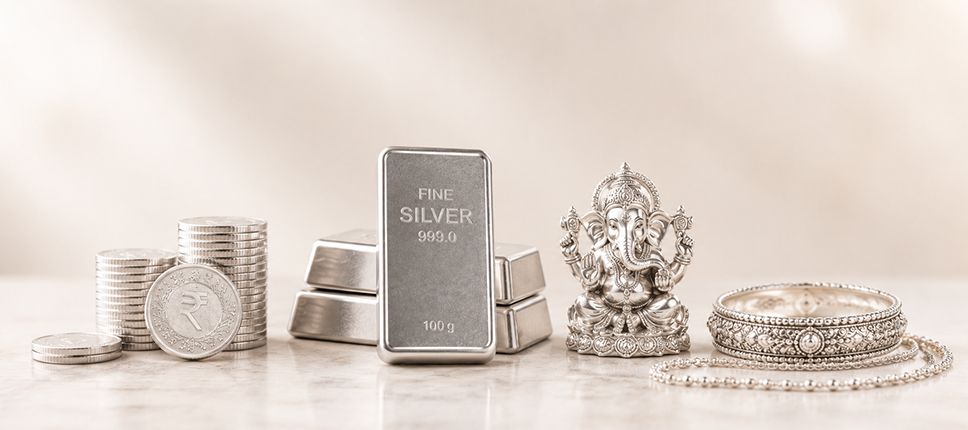
Silver can be bought and held in five distinct ways in India, each with its own minimum investment, cost structure, and liquidity profile.
Physical Silver: Bars, Coins, and Jewellery
Physical silver gives you direct, tangible ownership with no dependence on a platform or fund manager, but it comes with the highest all-in costs of any route.
Silver bars and coins are the more investment-friendly physical formats. A 3% GST applies on purchase, and making charges on bars and coins are typically much lower than on jewellery. Look for BIS hallmarking, which certifies purity - investment-grade silver is usually 999 fine.
Jewellery is the least efficient format for pure investment. Making charges typically range from 8% to 25% of the item's value, and this cost is rarely recovered on resale, since dealers buy back jewellery at the prevailing spot price minus a discount, not at what you originally paid including making charges.
Storage is another ongoing cost to factor in - a bank locker typically costs between ₹1,500 and ₹5,000 per year, depending on size and city. Physical silver is ideal for investors who want to own physical silver specifically with no counterparty risk and are comfortable handling storage and security themselves.
Silver ETFs: Stock-Exchange Listed, SEBI-Regulated
Silver ETFs allow you to buy and sell silver exposure on the stock exchange like a share without taking delivery or arranging storage.
SEBI regulation mandates that the Silver ETFs in India need to hold 99.9% pure physical silver, stored in secure vaults and the underlying holdings need to be verified periodically by an auditor. This gives ETF investors a regulatory layer of protection that physical or digital silver purchases do not have. Expense ratios on Silver ETFs typically fall in the 0.40-0.60% range annually, and because the fund tracks the domestic silver price rather than replicating it perfectly, a small tracking error between the ETF's returns and actual silver price movement is normal.
To invest, you need a demat and trading account, since ETF units are held and traded like shares. The minimum investment is the price of a single unit, which broadly tracks the silver price and has moved well above its earlier levels amid the sharp price increases silver has seen recently - check the current unit price on the exchange before investing. Silver ETFs suit investors who are already comfortable with a demat account and want low-cost, liquid, SEBI-regulated silver exposure without physical storage concerns.
Silver Fund of Funds: Invest Without a Demat Account
A Silver Fund of Funds (FoF) invests in units of a Silver ETF on your behalf, but you can buy into it directly through a mutual fund platform without needing a demat account at all.
This structure is particularly useful for SIP investors, since Silver FoFs typically allow systematic investments starting from as little as ₹100 to ₹500 per month, letting you build a silver holding gradually rather than committing a lump sum. Aditya Birla Sun Life offers both ETF and fund-based routes for silver exposure, giving investors a choice based on whether they already have a demat account.
Because a Fund of Funds adds a second layer - the fund invests in the ETF, which in turn holds physical silver - its expense ratio tends to run somewhat higher than a direct ETF investment. This route suits SIP investors and anyone without a demat account who wants regular, disciplined exposure to silver prices without opening a trading account solely for that purpose.
Digital Silver: Convenient, but Carries Platform Risk
Digital silver platforms let you buy fractional grams of silver online, which the platform operator holds in a vault on your behalf, without any demat account or minimum lot size.
The appeal is accessibility: some platforms allow investments starting from as little as ₹1, making this the lowest-entry-point route to silver ownership. However, this convenience comes with a trade-off that is worth stating plainly. SEBI has issued a public advisory cautioning investors about digital gold and similar digital metal platforms, noting that they do not carry the same direct regulatory oversight as ETFs and that investors are exposed to counterparty risk - if the platform operator runs into financial difficulty, your claim on the underlying silver may be affected.
Before using a digital silver platform, it is worth verifying who the vault custodian is, whether the holding is insured, and what regulatory registrations the platform holds. This route suits investors who want to start with very small, fractional amounts and who understand and accept the platform risk involved, rather than assuming it carries ETF-equivalent protection.
Silver Futures on MCX: For Experienced Traders Only
MCX silver futures are standardised contracts, typically in lots of 30 kg, used mainly for trading and hedging rather than long-term investment.
Positions are marked to market daily, meaning gains and losses are settled each trading day based on the contract's closing price, which can require topping up margin on short notice during volatile sessions. In terms of taxes, gains from silver futures trading are considered speculative business income, not capital gains, and that shifts their role in your overall tax plan. This strategy is for seasoned traders who can bear the risk and are able to watch their trades on a regular basis - it’s not for long-term investors or silver novices.
Silver Investment Comparison: Costs, Tax, and Liquidity at a Glance
| Investment Type | Minimum Amount | Key Costs | Liquidity | Tax Treatment | Demat Needed |
|---|---|---|---|---|---|
| Physical Silver | ~₹500–1,000 for small coins | 3% GST; making charges (8–25% for jewellery); storage | Moderate - sale via dealer at spot minus discount | LTCG (>24 months) at 12.5% without indexation; STCG at slab rate | No |
| Silver ETF | Price of 1 unit | Expense ratio (~0.40–0.60% p.a.); brokerage | High - traded on exchange | Same as physical silver from FY2024-25 onwards | Yes |
| Silver Fund of Funds | ₹100–500 (SIP) | Slightly higher expense ratio than direct ETF | Moderate - redemption via AMC, T+2/3 days | Same as physical silver from FY2024-25 onwards | No |
| Digital Silver | From ₹1 | Buy-sell spread; no SEBI-equivalent oversight | Moderate - sell-back via platform | Taxed at slab rate | No |
| MCX Futures | Contract margin (higher outlay) | Margin, daily mark-to-market | High, but for active positions only | Speculative business income | No (trading account) |
Under the current tax framework, physical silver and Silver ETFs are treated alike: gains on holdings sold after 24 months qualify as long-term capital gains, taxed at 12.5% without indexation benefit, while gains on shorter holding periods are added to income and taxed at your applicable slab rate. Digital silver is taxed at slab rate regardless of holding period, and MCX futures gains are taxed as speculative business income. Tax rules can change, so confirm current treatment with a tax adviser before making a large allocation decision.
Also Read: Digital Silver SIP
How Much Silver Should You Hold in Your Portfolio?
A silver allocation of roughly 5-10% of your overall portfolio is a reasonable starting point for most investors, and the rationale comes directly from silver's volatility profile.
Silver's beta to gold - a measure of how much more it moves for a given move in gold - runs approximately 1.5 to 2 times. In practice, this means silver tends to rally harder than gold in a bull phase but also fall further in a downturn. A smaller allocation captures the diversification benefit of holding a metal with different demand drivers than gold, without letting that volatility dominate your overall portfolio returns.
This is a meaningfully smaller allocation than the 10-15% many advisers suggest for gold, precisely because gold's price behaviour is comparatively steadier. It is also worth remembering that silver's heavy industrial demand linkage cuts both ways: during an economic slowdown, when industrial consumption falls, silver can underperform gold even though both are precious metals. Because your ideal allocation depends on your own risk tolerance and time horizon, it is worth reviewing your silver holding at least once a year and rebalancing if it has drifted meaningfully from your target. Investors closer to retirement or with a lower risk tolerance may prefer to stay near the lower end of the 5-10% range, while those with a longer investment horizon and higher risk appetite may be comfortable holding closer to the upper end.
What Drives the Price of Silver in India?
Four factors primarily determine the price you see quoted for silver in India on any given day.
The starting point is the global spot price, set on international markets such as COMEX and the LBMA in US dollars. This gets converted into rupees, so the INR/USD exchange rate directly affects the domestic price - a weaker rupee raises the rupee cost of silver even when the dollar price is unchanged.
Industrial demand is the second driver. Demand from solar panel manufacturing, electric vehicle production and electronics is a significant and expanding component of global consumption, and changes in this demand can influence prices regardless of investment sentiment.
Third, investment demand. Like gold, silver attracts safe-haven buying when markets are stressed or economic uncertainty reigns, which can push up prices even if industrial demand is stagnant.
Finally, there is an India-only layer in the form of domestic import duty and GST. There is a 3% GST at the point of sale and customs duty on silver imports that affects the landed cost before it reaches Indian buyers. Duty levels have changed in recent budgets, so it is worth checking the current rate rather than assuming it is fixed. This domestic charge means that Indian silver prices do not always move in perfect lockstep with international spot prices – the gap between the two can widen or narrow depending on duty changes and currency movements.
How to Start Investing in Silver: A Step-by-Step Guide
There are two practical paths to get started, depending on whether you already have a demat account.
Path A - Silver ETF via demat account:
- Open a demat and trading account with a registered broker.
- Complete your KYC using PAN and address proof.
- Search for a Silver ETF listed on the NSE or BSE.
- Place a buy order at the market price or set a limit price.
- Monitor your holding through your broker's app, alongside your other investments.
Path B - Silver Fund of Funds via a mutual fund platform:
- Complete your KYC on a mutual fund investment platform.
- Search for a Silver Fund of Funds scheme.
- Choose between a lump-sum investment or a monthly SIP.
- Set your SIP amount, starting from as little as ₹100-500 per month.
- Track your investment's NAV on a monthly basis rather than daily, since silver FoFs are meant for a gradual, longer-term approach.
Both paths are SEBI-regulated and do not require you to arrange physical storage. If you would rather avoid a demat account altogether or want to start with small, regular amounts, exploring Aditya Birla Sun Life's silver-linked fund options is a reasonable way to begin.
Also Read: Best Time to Buy Silver in India
Frequently Asked Questions About Silver Investment in India
Is there a Sovereign Silver Bond in India like the Sovereign Gold Bond?
No, the Indian government does not have a Sovereign Silver Bond scheme as of 2025. Silver does not have a government-backed bond equivalent like gold. Instead, investors can choose Silver ETFs or Silver Fund of Funds for regulated silver exposure.
Is GST applicable when buying Silver ETFs?
No GST is charged on Silver ETF transactions on stock exchanges. GST at 3% applies only when buying physical silver - bars, coins, or jewellery - from a dealer. This makes ETFs more cost-efficient than physical silver for pure investment purposes.
How volatile is silver compared to gold?
Silver is a much more volatile metal than gold. It can move 2-5% in a single trading session. Silver's beta to gold is roughly 1.5-2x meaning it tends to run harder in bull markets, but also falls harder in downturns, which is why it's generally recommended that you keep a smaller allocation to silver in your portfolio.
Can I invest in silver via SIP in India?
Yes. Silver Fund of Funds allow SIPs, usually from ₹100-500 a month. This does not require a demat account and allows investors to gradually increase exposure to silver through rupee-cost averaging. Silver ETFs do not offer direct SIPs but can be bought in small amounts on exchanges.
What is the minimum amount needed to invest in silver in India?
The minimum varies by route: digital silver platforms allow investments from ₹1; Silver ETFs can be bought for the price of one unit; Silver Fund of Funds SIPs start from ₹100-500 per month; physical silver coins start from around ₹500-1,000. MCX futures require a much larger margin outlay.
Is digital silver safe to invest in?
Digital silver platforms are not directly regulated by SEBI in the same way as ETFs. SEBI has issued a public advisory cautioning investors about risks in digital gold and similar instruments, including counterparty risk if the platform operator faces financial difficulty. Verify the vault custodian, insurance cover, and the platform's regulatory status before investing.
The information contained herein is generic in nature and is meant for educational purposes only. Nothing here is to be construed as an investment or financial or taxation advice nor to be considered as an invitation or solicitation or advertisement for any financial product. Readers are advised to exercise discretion and should seek independent professional advice prior to making any investment decision in relation to any financial product. Aditya Birla Capital Group is not liable for any decision arising out of the use of this information.
.svg)


.webp)
