
.gif)
.png)
.png)
.svg)
.svg)
.png)
.svg)

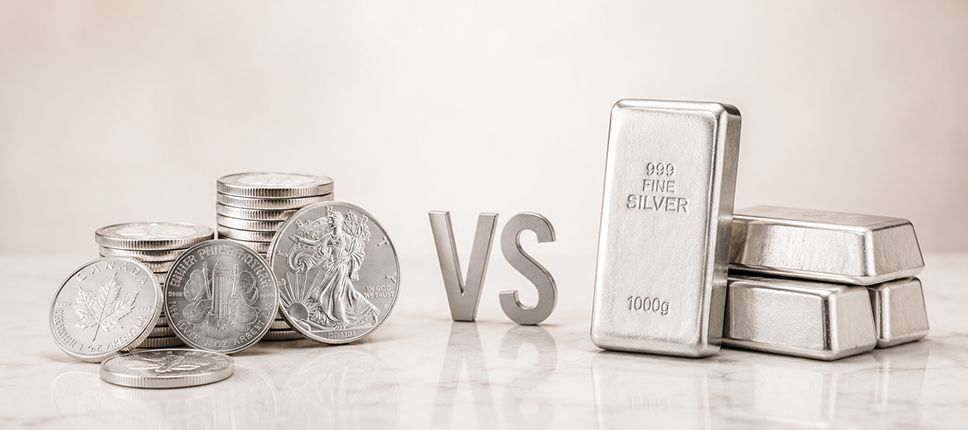
- Silver Coins vs Silver Bars: Key Differences at a Glance
- What Are Investment-Grade Silver Coins? Purity, Weights and Formats
- Common Silver Coin Weights Available in India
- What Are Investment-Grade Silver Bars? Sizes, Purity and Formats
- True Cost of Buying Silver Coins vs Bars in India: GST, Premium and Storage
- GST on Physical Silver: What Buyers Often Miss
- Liquidity and Resale: How Easy Is It to Sell Silver Coins and Bars in India?
- Physical Silver Coins vs Digital Silver: Which Suits Indian Investors Better?
- Silver Price Outlook: What Indian Coin Investors Should Know
- Which Should You Choose? A Decision Guide Based on Your Investment Profile
- Frequently Asked Questions About Silver Coin Investment in India
If you ask which is better for investment in India: Silver coins or silver bars, most dealers have a similar reply that silver coins cost more than bars. A 10-gram silver coin and a 10-gram silver bar are usually sold at the same rate, and both cost noticeably more per gram than a 1 kg bar.
That reframes the silver coin investment decision. Coins still win on partial liquidity, gifting and small budgets; bars still win on cost for larger sums. But the gap comes from the minting cost spread over the metal, not from the format. Both attract 3% GST, are rated at 999 fineness, and neither is yet covered by mandatory hallmarking in India.
Silver Coins vs Silver Bars: Key Differences at a Glance
| Reasons | Silver Coins | Silver Bars |
|---|---|---|
| Common weights in India | 5g, 10g, 20g, 50g, 100g | 10g to 1kg |
| Typical entry cost | Under ₹3,000 for 10g | ₹2.4 lakh for 1kg |
| Per-gram premium | Driven by weight, not shape | Lowest at 500g–1kg |
| GST | 3% | 3% |
| Purity sold | 999 / 999.9 | 999 / 999.9 |
| Storage | Easy, stackable, low bulk value | Higher value per unit, needs a locker |
| Partial resale | Sell a few pieces at a time. | All or nothing |
| Gifting | Sealed, serialised, festival-friendly | Rarely gifted |
| Best for | Budgets under about ₹25,000 | Single purchases above ₹1 lakh |
At the same weight, coins and bars from an accredited Indian refiner are usually priced identically. So the real question is not "coin or bar" but how big a piece you can buy in one go and whether you will need to sell it in parts.
What Are Investment-Grade Silver Coins? Purity, Weights and Formats
Investment-grade silver coins are round pieces of 999 fine silver (99.9% pure) or 999.9 fine, sold by weight rather than for their design. They come sealed in tamper-evident packaging with an assay certificate and a serial number, so the piece can be traced back.
- Most of what Indian dealers call silver coins are technically rounds: bullion struck by a refinery, not legal tender from a government mint. It makes no difference to the metal value.
- Collectable coins are a different product. Commemorative and numismatic pieces are priced on rarity and design, not silver content. Good for a collector, poor for an investor: you pay for the story, and the resale market is thin.
BIS hallmarking on silver is voluntary. This is the point most articles get wrong. Gold jewellery hallmarking is mandatory across 380 districts; silver is not. For bullion, refiner accreditation matters more than a hallmark: IS 17278 covers refined gold and silver bars for good delivery, and LBMA accreditation is the international equivalent.
Common Silver Coin Weights Available in India
Indian refiners typically offer coins in 5g, 10g, 20g, 25g, 50g and 100g weights, with bars ranging from 10g to 1kg. Here is what those weights actually cost. The table uses live GST-inclusive prices from one Indian refiner on 3 August 2026, when its 1 kg bar was quoted at ₹2,39,380. Rates move through the day (i.e 3rd August, 2026), so treat the data as a snapshot of the shape of the pricing, not a quotation.
| Weight | Price (incl. GST) | Per gram | Premium over the 1 kg rate |
|---|---|---|---|
| 10 g | ₹2,715 | ₹271.50 | +13.4% |
| 20 g | ₹5,113 | ₹255.65 | +6.8% |
| 50 g | ₹12,308 | ₹246.16 | +2.8% |
| 100 g | ₹24,284 | ₹242.84 | +1.4% |
| 250 g | ₹60,099 | ₹240.40 | +0.4% |
| 500 g | ₹1,20,137 | ₹240.27 | +0.4% |
| 1 kg | ₹2,39,380 | ₹239.38 | - |
Notice how quickly the premium falls away. Moving from 10g to 50g cuts your per-gram cost by more than 9%; moving from 100g to 1kg saves barely 1.4%. The expensive decision is buying in tiny pieces, not buying coins.
What Are Investment-Grade Silver Bars? Sizes, Purity and Formats
Silver bullion bars are rectangular ingots, usually 999 or 999.9 fine, sold in the same weight ladder as coins but extending further up. The 1kg silver bar is the standard large denomination for Indian retail investors, and it has the lowest per-gram cost.
Bars cost less per gram at the top end because minting, packaging and certification cost roughly the same for a 10g piece as for a 1kg piece, so the fixed cost is spread thinner. A 1 kg bar carries one certificate and one serial number instead of a hundred.
The trade-off is liquidity in pieces. Hold ₹2.4 lakh as a single 1kg bar, need ₹40,000, and you cannot cut off 170 grams; you sell the whole bar and re-buy, paying a fresh premium and a fresh 3% GST on the way back in. Ten 100g pieces cost about ₹3,460 more than one 1kg bar, and that ₹3,460 buys the ability to exit in tenths.
Buy from a refiner you can name. An unbranded bar with no certificate gets discounted or sent for testing. And a 1 kg bar concentrates a lot of value in one small object, which usually means a bank locker; a real annual cost, and one where the bank does not insure the contents.
True Cost of Buying Silver Coins vs Bars in India: GST, Premium and Storage
Four things sit between the spot price and what you pay:
- Spot price, set internationally in dollars and converted at the USD-INR rate.
- Import duty of 6% on silver bullion, plus 5% basic customs duty and 1% agriculture infrastructure and development cess, already baked into the Indian rate.
- Minting and dealer premiums, as well as the weight-driven gap shown above, are included.
- GST at 3% on the purchase value.
Work through 100 grams in three ways at the 3 August 2026 prices:
- Ten 10g pieces: ₹27,150
- Two 50g pieces: ₹24,616
- One 100g piece: ₹24,284
Buying that 100 grams in ten small pieces costs ₹2,866 more than buying it as one piece, which is about 11.8%. Splitting it into two 50g pieces costs ₹332 more, or 1.4%. Flexibility in halves is cheap. Flexibility in tenths is not.
Now you have to earn back that gap. Strip the GST out of the 1 kg rate, and you get about ₹232 a gram as a wholesale reference:
- A 1 kg bar at ₹239.38/g starts about 3% above wholesale; that gap is essentially just the GST.
- A 10 g coin at ₹271.50/g starts about 17% above wholesale, with GST plus the small-piece premium.
Silver has to rise by that much before you are level; and that is before the discount a buyer applies when you sell. Storage costs are added every year you hold.
GST on Physical Silver: What Buyers Often Miss
GST on silver coins and bars in India is 3% of the value of the metal. Jewellery-making charges, if billed separately, attract 5%, but that does not apply to plain coins and bars.
Two things buyers routinely get wrong.
- Digital silver is not GST-free. That claim is common and incorrect. Digital gold and silver are treated as goods because each purchase is backed by real vaulted metal, which means that a 3% GST applies as soon as you buy; for example, if you invest ₹1,000 in digital silver, about ₹30 goes to tax before you own anything. What genuinely avoids GST at purchase are silver ETFs and fund-of-funds, because units of a scheme are securities, not metal.
- You cannot recover it. A GST-registered jeweller claims input tax credit; an individual investor cannot. The 3% is a permanent entry cost and cannot be set off against capital gains later.
Also Read: What is Digital Silver? Meaning, How It Works & Complete Guide (2026)
Liquidity and Resale: How Easy Is It to Sell Silver Coins and Bars in India?
There are three practical exits, and one of them is not what most people assume.
- Jewellers and bullion dealers are the main route. Rates vary by shop and sit below the day's spot price. Sealed packaging, an intact serial number, the assay certificate and the original invoice all help; loose metal invites testing and a bigger discount.
- Banks sell but do not buy back. RBI norms do not permit banks to repurchase the coins they sell. Buy at a branch premium, and you will still be selling to a jeweller or bullion buyer at market rates, which makes bank-sold coins a weak option for pure investment.
- Refiner and online buyback are the third route and the most predictable. Several Indian refiners and bullion platforms run a stated buyback for their own branded products, sometimes only offline or through authorised outlets.
Bars from recognised refiners sell easily in bulk; coins sell in convenient chunks; digital silver and ETFs settle in a day or two. Whatever you buy, keep the invoice: it sets your cost of acquisition for capital gains and your claim on the buyback.
On tax at exit: physical silver held for more than 24 months is taxed as a long-term capital gain at 12.5% without indexation; sold sooner, the gain is added to your income at the slab rate. Two rules also apply at the counter; nobody may accept ₹2 lakh or more in cash for a single transaction, and PAN is required for bullion purchases above ₹2 lakh, whatever the payment mode.
Physical Silver Coins vs Digital Silver: Which Suits Indian Investors Better?
| Reasons | Physical Coins/Bars | Digital Silver | Silver ETF |
|---|---|---|---|
| GST at purchase | 3% | 3% | None |
| Minimum investment | One 5g or 10g piece | ₹10 or less | One unit |
| Ongoing cost | Locker, insurance | Platform spread, vault fees after some years | Expense ratio |
| Storage risk | Yours | Platform's vault | None |
| Counterparty risk | None | Yes. | Regulated fund structure |
| Regulator | - | None | SEBI |
| Liquidity | Depends on the buyer | Same-day on the app | Same-day on the exchange |
| Long-term capital gains | 12.5% after 24 months | 12.5% after 24 months | 12.5% after 12 months |
The regulatory point deserves emphasis. In a public caution SEBI said digital gold and e-gold products are neither notified as securities nor regulated as commodity derivatives, and that securities-market investor protections do not apply. The same logic covers digital silver: legal, backed by real metal, but with no SEBI grievance route if a platform fails.
That leaves a three-way split. Physical coins for people who want the metal in hand. Digital silver for very small, frequent accumulation, with platform risk accepted. Silver ETFs for anyone who mainly wants the price exposure: no GST, no storage, SEBI oversight, and long-term treatment after 12 months instead of 24.
Silver Price Outlook: What Indian Coin Investors Should Know
Start with what already happened, because the usual question is out of date.
"Will silver touch ₹2 lakh per kg?" It already has. Indian silver crossed ₹2 lakh per kg in late December 2025, when MCX futures hit a then-record ₹2,42,000. Globally, silver went from under $30 an ounce in early 2025 to an all-time high near $121.6 on 29 January 2026.
Then it fell roughly 30% in a day and a half. By early August 2026, silver traded near $58 an ounce, about half its January peak, but was still up more than 50% year on year. In India, that works out to roughly ₹2.2–2.4 lakh per kg, varying by city and dealer. That round trip is the most useful thing a first-time buyer can know about silver: milestones get hit and lost quickly.
Will silver go up over the next five years? The structural argument rests on a persistent supply gap. The Silver Institute's World Silver Survey 2026, published on 15 April 2026 with Metals Focus, put the 2025 deficit at 40.3 million ounces and forecast a sixth straight deficit of 46.3 million ounces in 2026, with roughly 762 million ounces drawn from above-ground stocks since 2021.
The counter-argument is in the same report. Industrial demand fell 3% in 2025 to 657.4 million ounces and is forecast to fall another 3% in 2026, largely because high prices are pushing solar manufacturers to use less silver per cell. Indian jewellery demand dropped about 20%. Coin and bar demand, meanwhile, is expected to rise sharply. Read together: the deficit is holding because supply is shrinking too, not because industry is buying more.
Analysts also watch the gold-silver ratio, which stood near 70:1 in early August 2026; gold around $4,043 an ounce against silver near $58; against a long-run average since 1971 of about 60.5 and a 52-week range of 46 to 90. A ratio above average is often read as silver looking cheap relative to gold. It is a rough signal, not a forecast.
For a 100g holder, the arithmetic is simple. At around ₹240 a gram, 100 grams is roughly ₹24,000. A move back to the January highs would about double that; a repeat of the January crash would about halve it. Both happened inside the last eight months.
Which Should You Choose? A Decision Guide Based on Your Investment Profile
- Under ₹10,000: buy 20g or 50g pieces rather than 10g. A 10 g piece costs about 13% more per gram than a 1 kg bar; a 50 g piece is under 3% more. Coins and bars price the same here, so pick whichever you prefer to hold.
- ₹10,000 to ₹50,000: 50g and 100g pieces. By 100 g, you have captured almost all the available discount and kept the ability to sell in parts.
- ₹50,000 to ₹1 lakh: a mix of 100 g and 250 g. Going bigger saves very little from here.
- Above ₹1 lakh, 500g and 1kg bars offer the lowest per-gram cost, but only if you are confident you will not need to sell a portion.
- You may need to exit in stages: stay with 50g or 100g pieces regardless of budget. The extra cost is about 1.4% over a 1 kg bar, which is far less than the cost of breaking a large bar and re-buying.
- Buying to gift: coins in sealed, serialised packaging.
- You do not want storage or locker costs at all: a silver ETF avoids GST, storage and the 24-month holding requirement.
A mix is perfectly reasonable: a core in larger bars for cost efficiency, a few 50g pieces for flexibility, and an ETF position for anything you might need to liquidate fast.
Also Read: Best Ways to Invest in Silver in India
Frequently Asked Questions About Silver Coin Investment in India
Are silver coins a good investment?
Silver coins can work as a long-term holding for investors who want a tangible asset with both industrial and monetary demand behind it. Weigh three costs: 3% GST you cannot recover, a per-gram premium that rises sharply below 50g, and storage. They suit smaller budgets and anyone who may want to sell in parts.
How do I invest in silver coins?
Buy 999 or 999.9 fine coins from an accredited refiner, a recognised bullion dealer or an established online platform. Compare the per-gram price, including GST, against the day's spot rate before paying. Choose sealed, serialised packaging, confirm the buyback terms in writing, store the coins securely, and keep the invoice and assay certificate.
What will silver be worth in 10 years?
Nobody knows, and anyone quoting a firm figure is guessing. The structural case rests on six consecutive years of supply deficit and demand from electronics, EVs and power infrastructure. The risks are thrifting in solar manufacturing, higher mine output and silver's own volatility; it lost close to half its value inside a week in early 2026.
Will silver touch ₹2 lakh per kg in India?
It already did. Indian silver crossed ₹2 lakh per kg in December 2025 and went considerably higher in January 2026 before falling back to roughly ₹2.2–2.4 lakh per kg by August 2026.
Will silver go up over the next five years?
The supportive factors are a sixth consecutive annual supply deficit, demand from grid infrastructure and AI-related electronics, and a gold-silver ratio above its long-run average. Against that: solar makers are cutting silver per cell, Indian jewellery demand has fallen, and much of the recent rise came from investment flows that can reverse quickly.
How much is 1 kg of silver now?
It changes daily with the global spot price and the USD-INR rate. In early August 2026, it was roughly ₹2.2–2.4 lakh per kg depending on the city and dealer. A physical 1 kg bar costs more than the spot rate, because the price you pay includes 6% import duty, the refiner's premium and 3% GST. Check a live rate before you buy.
The information contained herein is generic in nature and is meant for educational purposes only. Nothing here is to be construed as an investment or financial or taxation advice nor to be considered as an invitation or solicitation or advertisement for any financial product. Readers are advised to exercise discretion and should seek independent professional advice prior to making any investment decision in relation to any financial product. Aditya Birla Capital Group is not liable for any decision arising out of the use of this information.
.svg)


.webp)
