Home Finance
 Personal Finance
 SME Finance
 Loan Against Securities
 Business
 Mutual Funds
 Stock and Securities
 Portfolio Management Services
 Pension Funds
 Real Estate Investments
 Life Insurance
 Health Insurance
 Multiply Wellness
 Motor Insurance
 Travel Insurance
 Pay Bills
 Pay anyone
 Pay on call
 Payment Lounge
 ABC Credit Cards



 1800-270-7000

 ENG
ENG 


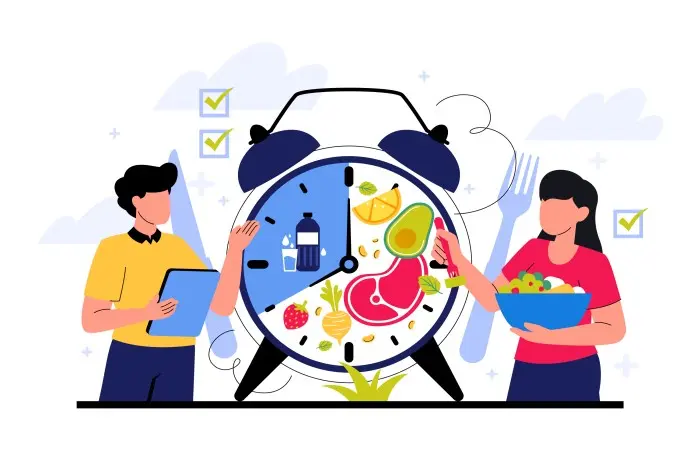
Human Body and Meal Time: How Your Body Processes Food At 11 AM vs 11 PM
If you’ve ever consulted a dietician or nutritionist or asked a doctor for advice on food, the first thing they say is to eat a balanced diet, and rightly so. Having a perfect meal consistently with all the necessary macronutrients and micronutrients, like carbohydrates, protein, fat, vitamins, and minerals, is the best and simplest way to remain healthy. But what is the best time to have these meals? What if I eat my breakfast at 11 AM and my dinner at 11 PM? Is it still healthy? Well, people rarely ask these questions. But here’s your answer: Your meal timing is just as important to how your body processes food. Let’s dig deeper to learn more.
Why Meal Timing Matters?
The human body is like a high-functioning machine, governed by the phenomenon called the circadian rhythm. It is the body’s natural 24-hour clock that regulates bodily functions like sleep, metabolism, temperature, and hormones. Circadian rhythm is controlled by a group of 20,000 cells, also known as the suprachiasmatic nucleus, a part of the hypothalamus that works like a clock and responds to light signals our eyes receive.
How your body reacts to food depends entirely on how well your eating and sleeping patterns align with the circadian rhythm. So, what does eating at 11 AM or 11 PM mean to the body?
What Eating at 11 AM Means To Your Body?
When you eat your first meal at 11 a.m., your body treats it as a reset point for its circadian rhythm and considers it the first major meal of the day. At this time, your body maintains active levels of cortisol, the hormone associated with wakefulness, while melatonin, the hormone that promotes sleep, remains low. Your system also has higher insulin sensitivity during these daylight hours, which helps with improved metabolism compared to a meal later in the day. Having food within the 11 AM window also helps the body manage energy efficiently and limits fat accumulation.
What Eating at 11 PM Means To Your Body
Eating at 11 pm, on the other hand, puts considerable pressure on the body as it disrupts the circadian rhythm. This is because you force your body to digest and metabolise food when it is biologically programmed to sleep or rest. At 11 PM, melatonin levels are naturally high to prepare you for sleep; however, melatonin also tells the pancreas to slow down insulin production. This mismatch leads to higher blood sugar levels, reduces the body’s ability to burn fat, and increases fat accumulation. It can also create a cycle of poor appetite control the following day.
Your Body and Food at 11 AM vs 11 PM – A Quick Comparison
Let’s compare how your body processes food at 11 AM and 11 PM.
| Bodily Function | Eating at 11 AM | Eating at 11 PM |
| Sleep | No impact | Impacts sleep quality; keeps you awake |
| Metabolism | High & efficient | Low & slow |
| Digestion | Increased due to high enzymatic activity | Slowed as the digestive system expects rest |
| Insulin Response | High sensitivity; the body regulates sugar efficiently | High resistance; increased risk of blood sugar spikes |
| Impact on Weight | Minimal, as the body uses energy for daily tasks | High; can lead to weight gain and fat accumulation |
| Hormone Response | Active cortisol levels, signalling wakefulness | High melatonin, which clashes with food processing |
Final Takeaway
When it comes to eating, timing is just as important as the quality and quantity. Early eating is crucial for the body, as it enables the right functioning, whereas eating late puts unnecessary stress on the body, which can lead to potential health concerns in the long run. Don’t view eating early as a restriction; instead, treat it as you would working with your body to keep yourself healthy.
Frequently Asked Questions
Eating at 11 AM if you wake up around 8 or 9 AM is considered part of the circadian rhythm, whereas eating at 11 PM is going against it.
You’re likely to have poor sleep, increased chances of weight gain, and a potential risk of type 2 diabetes.
Yes. Eating at 11 PM can cause weight gain because the body is less efficient at processing calories at night.
At night, your body is designed to rest and perform cellular repair rather than processing, digesting, or metabolising heavy meals.
Yes. Consistently eating late at night can lead to health problems in the long run. It is a good practice to eat at least 2 to 3 hours before going to bed.