
 Home Finance
 Personal Finance
 SME Finance
 Loan Against Securities
 Business
 Mutual Funds
 Stock and Securities
 Portfolio Management Services
 Pension Funds
 Real Estate Investments
 Life Insurance
 Health Insurance
 Multiply Wellness
 Motor Insurance
 Travel Insurance
 Pay Bills
 Pay anyone
 Pay on call
 Payment Lounge
 ABC Credit Cards



 1800-270-7000

 ENG
ENG 


We all have hectic schedules these days, which makes exercising regularly a mighty task. But if you are new to the fitness journey, the best way to do it would be to ask yourself a couple of questions related to your body. One of the biggest questions that would make a difference is this: What is basal metabolic rate? Read on to learn all about it.
During the day, your body burns a certain number of calories while performing its basic functions. The Basal Metabolic Rate (BMR) calculates the basic calorie amount you need for the day. Here’s what you should know about BMR and how you can use it to stay healthy even as you grow older.
What is Basal Metabolic Rate?
The body uses energy only to maintain organs like the lungs, heart, kidneys, intestines, nervous system, liver, skin, and muscles. The Basal Metabolic Rate (BMR) calculates the calories you burn while:
- breathing,
- temperature regulation,
- blood circulation,
- nutrition processing
- cell production.

BMR helps determine your Total Daily Energy Expenditure (TDEE), therefore it can help you calculate if you are consuming an adequate number of calories as per your lifestyle. This way it can be useful to monitor your calorie consumption, especially if you want to keep your weight in check and build muscle mass in your body.
Difference Between BMR and RMR
To understand what BMR is properly, you must also know what Resting Metabolic Rate (RMR) is. Basal Metabolic Rate (BMR) and Resting Metabolic Rate (RMR) both describe how much energy your body needs while resting. The two are assessed differently, and that is where the variation in accuracy usually comes from.
BMR reflects the minimum energy your body needs to stay alive. It covers essential functions such as breathing, circulation, and ongoing cell repair. RMR is taken in a more everyday setting, so it shows what your body uses at rest without the strict controls required for a formal BMR test.
RMR is commonly used when planning fitness routines, nutrition goals, or daily calorie targets because it is easier to measure in real-world conditions. RMR is typically 10–20% higher than a person’s actual BMR, depending on individual factors. It’s important to recognise this difference to help you interpret your metabolic results accurately and set appropriate health and/or weight management goals.
How does age affect BMR?
Your metabolism includes all of the chemical reactions required to keep your body functioning. The faster your metabolism rate, the more calories you burn. As you grow older the metabolic rate tends to drop, which in turn lowers your BMR.
For instance, one study calculated the BMR of three groups of people:
i) between ages 20–34
ii) between the ages 60–74
iii) ages over 90
Compared to the youngest group, people aged 60–74 burned roughly 122 fewer calories, while people over 90 burned around 422 fewer calories.

Here are some of the reasons your age affects your BMR.
Slow metabolic processes
The mitochondria generate energy for your cells, while the sodium-potassium pumps generate nerve impulses as well as muscle and heart contractions. Both of these components slow down as you grow older, which progressively reduces your metabolic rate.
Muscle loss
An average adult can lose anywhere between 3-8% of muscle mass every decade after turning 30. This can be due to a reduction in physical activity, but also because the production of growth hormones, testosterone or estrogen also decreases.
Reduced activity
The amount of time you stay active in exercises and other physical activity tends to drop as you grow older. This means you burn fewer calories during the day, which leads to a slower metabolism.
How to calculate ideal BMR?
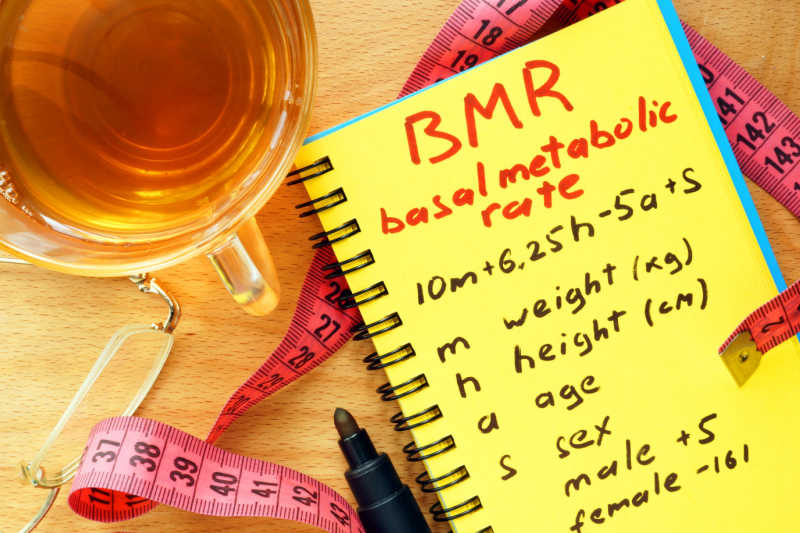
Traditionally, the normal range of your ideal BMR was determined by age and gender. Here is the DuBois normal standards for BMR breakdown or a BMR chart according to age bracket:
| Age | Male (calories per hour) | Female (calories per hour) |
| 20–29 | 39.5 | 37.0 |
| 30–39 | 39.5 | 36.5 |
| 40–49 | 38.5 | 36.5 |
| 50–59 | 37.5 | 35.0 |
| 60–69 | 36.5 | 34.0 |
| 70–79 | 35.5 | 33.0 |
However, the formula for BMR has evolved, and it now includes height and weight in the calculation too. Here’s the Revised Harris-Benedict Equation for BMR:
Male: 66.5 + (13.75 x weight in kgs) + (5.003 x height in cms) – (6.775 x age in years)
Female: 655.1 + (9.563 x weight in kgs) + (1.850 x height in cms) – (4.676 x age in years)
You can use this formula or simply use our basal metabolic rate calculator and find your ideal BMR.
What is a Healthy BMR for Your Age Group?
There is no single value that defines a healthy Basal Metabolic Rate. It shifts from person to person, depending on factors like age, sex, body composition, and inherited traits. It is also influenced by height, weight, and overall body surface area, which are central to most standard BMR equations. Most younger adults tend to have a higher BMR because their metabolism works faster, while older adults often show lower values as muscle mass naturally declines. Though the values listed above are averages, they will give you a general idea of how to compare your metabolism with others at your stage of life.
You can improve your BMR over the long term by maintaining a healthy level of lean muscle, exercising regularly, and eating a balanced, nutritious diet.
So, how to calculate BMR? Most people calculate it using established equations such as the Mifflin–St Jeor or Harris–Benedict formula, which factor in age, height, weight, and sex. Use these BMR ranges for reference and not as a tool for diagnosing health problems.
Average BMR by Age Group (Adults)
These figures are broad population estimates based on average height and weight profiles rather than fixed clinical values.
| Age Group | Average BMR (Women) | Average BMR (Men) |
| 18–29 | 1,350–1,550 kcal/day | 1,600–1,800 kcal/day |
| 30–39 | 1,300–1,500 kcal/day | 1,550–1,750 kcal/day |
| 40–49 | 1,250–1,450 kcal/day | 1,500–1,700 kcal/day |
| 50+ | 1,200–1,400 kcal/day | 1,450–1,650 kcal/day |
Importance of BMR
Knowing what good BMR is and understanding its importance can prove to be a crucial step if you are trying to maintain weight and lead a fit and healthy life. It will also help you determine your healthy metabolic age so that you can change your lifestyle to achieve your fitness goals. It will also help you understand the required calorie intake suited for your body.
How to lose weight using BMR?
If you plan to go on a fitness journey and want to achieve your goals, one of the most significant ways to determine that is by creating a calorie deficit. What that means is to see a change in your weight, you need to burn more calories than you consume. You can only calculate these figures with the help of your BMR and RMR.
Daily Calorie Needs Based on Your BMR
A simple way to estimate daily calorie use is to take your BMR and adjust it with an activity factor that reflects how active you are throughout the day. This figure is your Total Daily Energy Expenditure (TDEE).
Knowing your estimated calorie burn gives you a clearer base from which to plan your nutrition, whether the aim is weight loss, maintenance, or healthy gain.
Use the table below as a general guide to estimate daily calorie needs based on activity level.
Estimated Calorie Needs (Using BMR × Activity Factor)
| Activity Level | Activity Factor | Daily Calorie Needs Example (If BMR = 1,400 kcal) |
| Sedentary | 1.2 | ~1,680 kcal/day |
| Lightly Active | 1.375 | ~1,925 kcal/day |
| Moderately Active | 1.55 | ~2,170 kcal/day |
| Very Active | 1.725 | ~2,415 kcal/day |
| Extra Active | 1.9 | ~2,660 kcal/day |
The ‘Extra Active’ multiplier generally applies to individuals who combine very intense daily training with a physically demanding occupation.
How to speed up metabolism?
By understanding the RMR and BMR meanings, you can seek a professional’s help who will prescribe a customized diet and exercise regimen for you. Apart from that, drinking loads of water, walking and running regularly, sleeping well, lifting weights, incorporating muscle training in your fitness journey, and eating protein-rich foods can help speed up your metabolism. These steps will also help create a calorie deficit fit for your body.
Take these steps to maintain a healthy lifestyle and correctly calculate your BMR and RMR to fulfill all your health goals.
Key Takeaways:
- Your BMR offers a basic picture of how much energy your body needs while resting, and can help shape a balanced nutrition or exercise approach. Since metabolism tends to slow down with age, staying active and building muscle can help keep your BMR at a healthier level. Keeping track of your BMR and your daily calorie needs, along with maintaining healthy habits, can support long-term weight and well-being goals.
- For personalised support, especially for women managing metabolism and long-term well-being, understanding basal metabolic rate becomes even more relevant alongside women’s health insurance. The Importance of Womens Health Insurance extends to preventive care, nutritional guidance, and long-term health planning.
- Learn about current expert opinions on metabolism, healthy living, and how you can live a healthier life by staying connected to the Activ Living Community.
You may also be interested in the following blogs:
- New Calorie-Conscious Resolution Made? First Know The Ideal BMR For Your Age
- Stamina VS Endurance: Which Is More Important For Your Fitness Goals
Popular Searches
Diabetes Friendly Food | Plant Based Protein | Heart Attack Vs Cardiac Arrest | Diabetic Skin Conditions | Heart Attack Recovery | Breakfast For Heart Patients | Benefits Of Walking | Constipation | How To Get Good Sleep | High BP In Young Adults | Diet Plan To Loss Weight | Body Fat Percentage | Health Trends | AQI In Winter | Citrus Fruits | AI And Mental Health | Is It Good To Skip Breakfast | Everyday Habits For Health | How Body Processes Food | Is Raisin Good For Thyroid | Warm Water Vs Cold Water | Benefits Of Gond Katira | Health Checkups After 30s | VO2 Max | Smoking In Your 20s Vs 40s






Its very well written; I love what you’ve got to say.